
The EU’s Revised Energy Performance of Buildings Directive: Implications for the UK

Image from European Commission
While the UK is no longer an EU bloc member, revised building regulations from the European Union provide valuable considerations for the UK government in its pursuit of the 2050 net zero target. Jane Goddard, Deputy Chief Executive of the Building Research Establishment, discusses the potential impact of these changes.
Ambitious Low Carbon Policies in the EU
Despite a rise in populist right-wing parties in the European Parliament, Ursula von der Leyen’s centre-right European People’s Party remains influential. The new parliament is set to implement ambitious low carbon policies, particularly through the revised Energy Performance of Buildings Directive (EPBD).
Major Changes in Building Regulations
The revised EPBD introduces significant changes for both new and existing buildings across the EU’s 27 member countries. These regulations, although not directly applicable to the UK, present important considerations as the UK government works towards its own 2050 net zero target.
Whole-Life Carbon Emissions
Countries like Denmark, France, and the Netherlands have already imposed limits on both embodied and operational carbon emissions for new buildings. The UK has yet to implement such regulations. The revised EPBD mandates that by 2030, all new buildings in the EU must meet regulatory limits for whole-life carbon emissions, reported on the Energy Performance Certificate (EPC). Large new buildings will need to disclose whole-life emissions starting in 2028. The UK could adopt a similar or even more ambitious timeline.
Improving Energy Efficiency in Non-Domestic Buildings
Under the new EU regulations, member countries must identify and improve the least energy-efficient non-domestic buildings, targeting the worst 16% by 2030 and a further 10% by 2033. This phased approach aims to tighten minimum energy standards, addressing the significant energy use in business and public buildings. In England and Wales, the current requirement is a minimum EPC E standard for rented premises, provided the improvements are cost-effective.
Global Trends in Energy Standards
The EU is not alone in advancing energy standards for non-domestic buildings. US cities and states, such as New York City, have set long-term performance trajectories for larger business properties. The next UK government must consider whether and how to align with this global trend.
Transitioning to Low-Carbon Heat Sources
To promote low-carbon heat sources, the EU will prohibit new public funding for stand-alone fossil fuel heating systems, such as gas or oil boilers, starting in 2025. Additionally, the European Commission will develop a new framework for banks to support mortgage lending for retrofitting, facilitating private investment in the low-carbon transition.
Financing and Strategic Framework for Retrofit in the UK
While the UK has policies for retrofit financing and information, government-mandated funding through the Energy Company Obligation still supports new gas boilers. The challenge for the UK government is to establish a comprehensive long-term strategic framework for home retrofits, integrating information, financing, and regulatory policies into a unified low-carbon roadmap.
National Plans for Zero Emissions Building Stock
The EU requires member states to have national plans for achieving zero emissions in their building stock. The UK must develop its own roadmap to meet the national net zero target. A white paper on delivering world-leading building standards should be a priority for the next government to ensure the decarbonization of the UK’s built environment by 2050.
Conclusion
The revised EPBD sets a clear path for sustainable building practices in the EU, offering a valuable reference for the UK. By adopting similar or more ambitious measures, the UK can ensure it remains at the forefront of global efforts to create a sustainable built environment.
Sources
What the EU’s revised Energy Performance of Buildings Directive means for the UK — Inside Housing
Questions and Answers on the revised Energy Performance of Buildings Directive (EPBD) — European Commission
Related articles

2050 Materials joins Once For All Group
Today we are thrilled to announce that 2050 Materials has officially become part of the Once For All Group.
Read more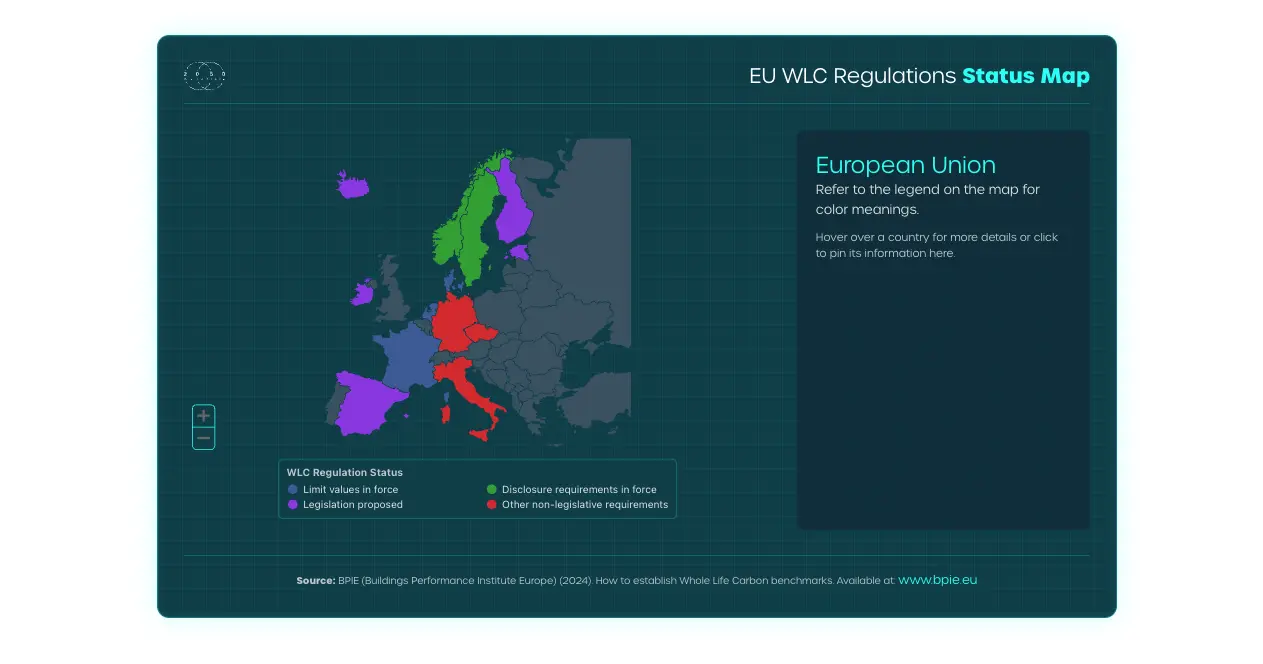
Mapping Europe’s Whole Life Carbon Policy Landscape (BPIE 2024)
Whole Life Carbon (WLC) assessments are essential for decarbonising construction by identifying a building's carbon hotspots. This approach drives innovation in low-carbon materials and technologies, leading to significant long-term value. Adopting WLC strategies can reduce costs, boost industry competitiveness, and create a skilled green workforce, all while promoting healthier buildings through sustainable materials.
Read more
2050 Materials × natureplus: Revolutionising Data
We’ve partnered with natureplus to bring ecolabelled building products into the digital age. By continuously reading their API, we’re integrating verified sustainability data—like health, carbon, and performance metrics—directly into our platform. It’s a major leap forward in the digitisation of environmental data, turning ecolabels into structured, searchable tools for better design decisions.
Read more