Case Study: Embodied Carbon Dashboards from BIM, an Integration with VIM & 2050 Materials
As the construction industry evolves and adjusts to the climate transition needed, visualising sustainability performance has become a crucial focus, with the need for continuous tracking of embodied carbon figures in buildings becoming increasingly prominent.
2050 Materials has partnered with VIM to offer an integrated solution that not only enriches Building Information Modeling (BIM) data but also enables real-time carbon tracking through dynamic visualisations.
 This case study highlights the partnership between VIM’s powerful data workflows and 2050 Materials’ vast carbon database and aims to help construction professionals make more sustainable decisions throughout a project’s lifecycle.
Integrating VIM AEC with 2050 Materials
The collaboration between VIM and 2050 Materials’ API delivers a powerful solution that enriches BIM data with accurate embodied carbon figures, enabling construction teams to monitor embodied carbon in real time.
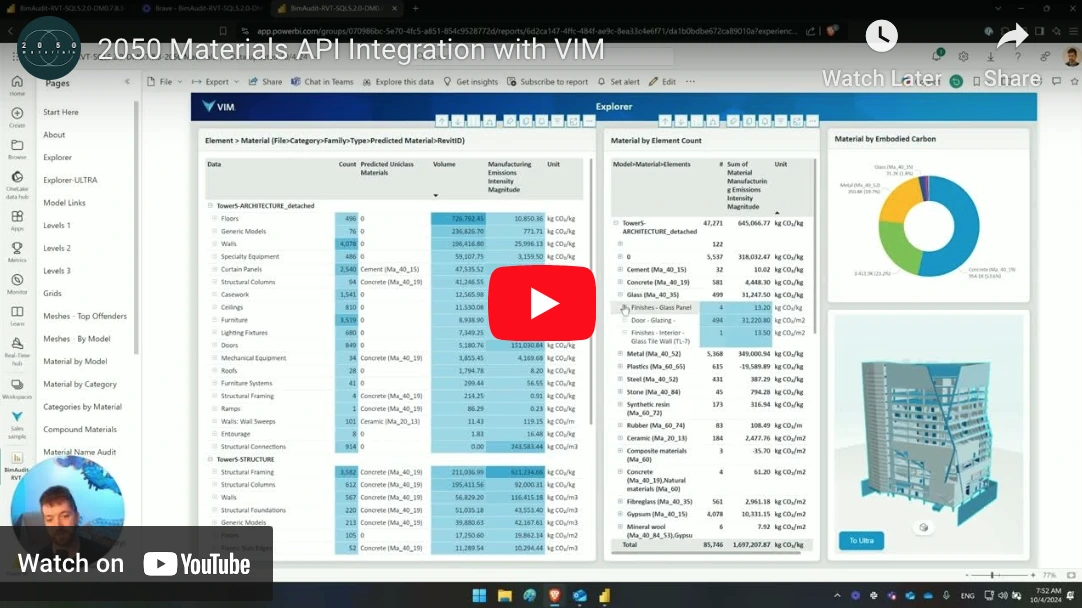
By integrating 2050 Materials’ automated BIM-to-embodied-carbon mapping, VIM users can obtain actionable dashboards in minutes. This unlocks a new kind of embodied carbon assessment, where digital teams can continuously monitor their project’s progress and make decisions accordingly.

How It Works
- Step 1: Upload your BIM file to VIM
- Step 2: Share access with 2050 Materials to enrich with embodied carbon figures
- Step 3: Run the VIM dashboard
The integration between VIM and 2050 Materials enhances sustainability tracking by embedding carbon data directly into BIM workflows, allowing real-time visibility of embodied carbon at every project phase. It features dynamic visualizations through VIM’s dashboards, helping teams monitor carbon metrics and meet sustainability targets. Automated carbon reporting further streamlines the process, reducing manual effort. Additionally, the unified data empowers teams to make informed, sustainability-aligned decisions regarding material selection and project design.
About VIM
VIM automates information workflows to help construction teams manage data throughout a building’s lifecycle. By integrating BIM data with Microsoft Power BI, VIM delivers scalable insights from federated models, reducing data silos and improving project coordination.
Key Benefits
- Comprehensive Insights: VIM aggregates data across disciplines, offering a holistic view of projects for better decision-making.
- Flexible Solution: Self-hosted infrastructure tailored to project needs, providing control and adaptability.
- Automation: VIM automates workflows and standardizes reporting, saving time and improving communication.
About 2050 Materials
2050 Materials provides real-time sustainability data to help construction teams reduce the environmental impact of building projects. By integrating material data into digital design processes, 2050 Materials enables data-driven decisions that support low-carbon construction and compliance with sustainability targets.
Key Benefits
- Comprehensive Insights: 2050 Materials aggregates environmental data for materials, offering a full view of a project’s embodied carbon and environmental impact.
- Flexible Solution: Seamless integration with design tools and APIs ensures adaptability to different project workflows.
- Automation: 2050 Materials automates sustainability reporting, saving time and improving accuracy for compliance efforts.
Get started
Reach out to us through info@2050-materials.com or by contacting us on our website.
Related articles
Turner & Townsend partners with 2050 Materials to strengthen cost & carbon intelligence
Turner & Townsend has partnered with 2050 Materials to integrate verified embodied carbon data directly into its Embodied Carbon Calculator (ECC), enhancing how cost and carbon are assessed together as the dual currencies of construction across project lifecycles.
Read more
How Concular Uses 2050 Materials’ Data Infrastructure to Power CircularLCA
This case study outlines why Concular adopted 2050 Materials’ API, how the integration works inside CircularLCA, and the measurable improvements in completeness and transparency for end users.
Read more
How Implenia Uses 2050 Materials for Early Carbon Decisions
Implenia, Switzerland’s largest construction and real estate company, is setting a new standard for low-carbon building by using the 2050 Materials platform during early design stages. For the first time, embodied carbon benchmarks were applied as a formal evaluation criterion in architecture competitions. By integrating real-time carbon analysis with Swiss standards like KBOB and SIA 2032, Implenia was able to make transparent, cost-effective carbon comparisons across design proposals—well before execution. The result: faster decisions, higher sustainability compliance, and a repeatable method for future low-carbon projects.
Read more