Turner & Townsend partners with 2050 Materials to strengthen cost & carbon intelligence

Delivering Net Zero Carbon buildings requires more than ambition; it requires clarity, data, and the ability to balance multiple priorities at once.
Turner & Townsend has partnered with 2050 Materials to integrate verified embodied carbon data directly into its Embodied Carbon Calculator (ECC), enhancing how cost and carbon are assessed together as the dual currencies of construction across project lifecycles.
Through the 2050 Materials platform, ECC can now access structured product-level carbon data from more than 182,036+ construction products sourced from verified EPDs and certifications, bringing greater transparency, consistency, and confidence to design-stage decision-making.
The vision: Managing the dual currencies of construction
Turner & Townsend pioneered the concept of managing the dual currencies of construction cost and carbon.
Their award-winning Embodied Carbon Calculator (ECC) was developed to:
- Ensure carbon counts are compliant with RICS WLCA v2
- Cover all building elements, including external works
- Provide clear, plain-English reporting on carbon performance.
At the heart of their approach are three core principles:
- Setting the carbon baseline to establish a meaningful benchmark
- Developing a “Counting to Zero” roadmap to improve performance
- Applying consistent measurement across each design stage.
To support this structured carbon accounting methodology at scale, ECC required a reliable, digital material data backbone which is now powered by 2050 Materials.
Why 2050 Materials
Balancing cost and carbon in real time requires more than high-level benchmarks. It requires product-specific, structured data that can integrate directly into digital tools.
Through the 2050 Materials platform, Turner & Townsend gains access to:
- Verified embodied carbon data at product level
- Harmonised lifecycle module values (A–D)
- Dataset validity dates and source traceability
- Manufacturer and production metadata
- Structured categorisation for consistent benchmarking.
Rather than manually reconciling datasets from multiple programme operators, ECC now queries a consolidated, normalised data layer, designed for digital integration.
How the integration supports ECC
1. Stronger data foundations
The ECC is pre-loaded with building materials and carbon emissions data from trusted sources.
The 2050 Materials data enhances this capability by:
- Expanding product coverage
- Structuring metadata consistently
- Ensuring direct links to original EPD documentation
- Supporting audit-ready reporting.
2. Whole-building carbon insight
Turner & Townsend’s ECC calculates the carbon impact of the whole building, including external works.
By embedding structured product-level data, the tool can:
- Improve completeness of material matching
- Strengthen module-by-module accuracy
- Reduce reliance on generic assumptions
- Provide clearer performance benchmarking.
3. Benchmarking with confidence
ECC benchmarks performance against:
- Client-specific carbon targets
- Industry benchmarks such as LETI
- Turner & Townsend’s internal dataset.
Because datasets are version-controlled and source-linked, benchmarking becomes more transparent and defensible especially in environments where carbon outcomes are increasingly scrutinised.
4. Faster, better design decisions
Starting carbon analysis early, from RIBA Stage 2, significantly improves outcomes.
With reliable product-level data embedded into ECC, teams can:
- Assess design alternatives quickly
- Understand cost and carbon impact simultaneously
- Avoid late-stage redesign and rework
- Maintain project pace while improving outcomes.
This strengthens the link between commercial value and carbon performance, reinforcing Turner & Townsend’s dual-currency philosophy.
The impact
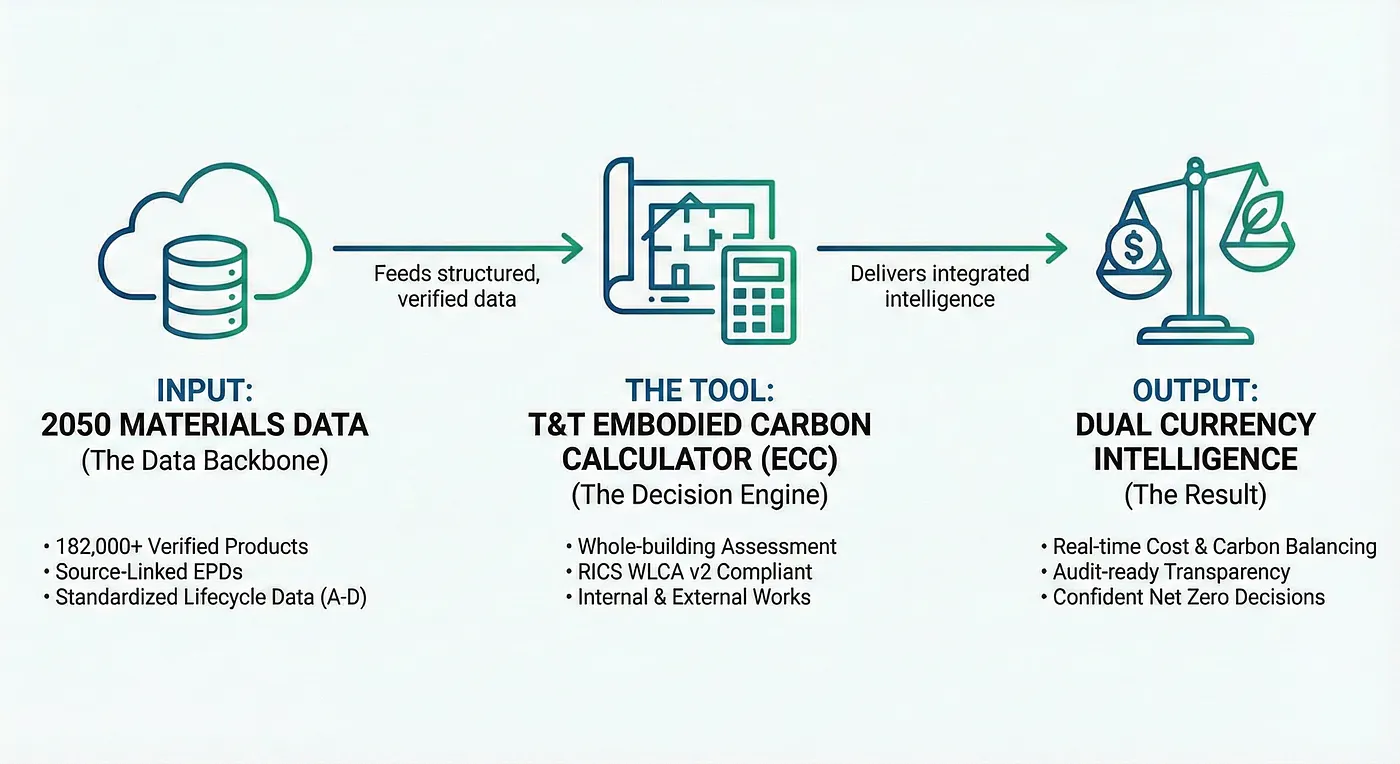
By integrating 2050 Materials data into ECC, Turner & Townsend enhances its ability to deliver carbon intelligence at scale.
Key outcomes include:
- Higher confidence in embodied carbon calculations
- Reduced manual data handling
- Improved benchmarking and transparency
- Stronger integration between cost management and carbon accounting
- More consistent measurement across project stages.
The result is a more connected digital workflow where carbon is not a separate calculation, but an embedded part of commercial decision-making.
A shared commitment to data-driven sustainability
Turner & Townsend positions itself as a leader in data, digital, and the economics of sustainability.
2050 Materials supports this ambition by providing:
- A scalable embodied carbon data infrastructure
- API integration capability into internal tools
- Structured, verified product-level datasets
- A foundation for transparent reporting and benchmarking.
Together, the partnership demonstrates how digital tools can move beyond reporting and actively shape better project outcomes.
Redefining cost & carbon integration
Integrating structured embodied carbon data directly into commercial workflows marks a meaningful shift in how projects are evaluated and delivered. As cost and carbon become equally critical performance metrics, alignment at both technical and strategic levels is essential.
Voices shaping this partnership share their perspective on why this collaboration matters and what it means for the future of cost and carbon intelligence.
 “Our clients require carbon assessments that are based on consistent, verifiable data to understand their projects impact, benchmark performance, and drive targeted reductions. Integrating the 2050 Materials data into our Embodied Carbon Calculator strengthens our ability to measure embodied carbon with the same discipline as cost, aligned with RICS WLCA v2.
Access to harmonised lifecycle modules and traceable product-level data enables more consistent benchmarking and earlier, more confident decision-making.”
- Mark Rogers, Head of Net Zero Carbon, Cost Management UK, Turner & Townsend
“As embodied carbon becomes central to procurement and investment decisions, data must be structured for integration, not just reporting.
Through our platform, Turner & Townsend can access harmonised lifecycle data with full traceability, enabling carbon intelligence to be embedded directly into cost workflows. This is how carbon moves from measurement to meaningful action.”
- Phanos Hadjikyriakou, Co-founder & CEO, 2050 Materials
“Our clients require carbon assessments that are based on consistent, verifiable data to understand their projects impact, benchmark performance, and drive targeted reductions. Integrating the 2050 Materials data into our Embodied Carbon Calculator strengthens our ability to measure embodied carbon with the same discipline as cost, aligned with RICS WLCA v2.
Access to harmonised lifecycle modules and traceable product-level data enables more consistent benchmarking and earlier, more confident decision-making.”
- Mark Rogers, Head of Net Zero Carbon, Cost Management UK, Turner & Townsend
“As embodied carbon becomes central to procurement and investment decisions, data must be structured for integration, not just reporting.
Through our platform, Turner & Townsend can access harmonised lifecycle data with full traceability, enabling carbon intelligence to be embedded directly into cost workflows. This is how carbon moves from measurement to meaningful action.”
- Phanos Hadjikyriakou, Co-founder & CEO, 2050 Materials
Looking ahead
As embodied carbon becomes a central performance metric across procurement, design, and delivery, integrating structured material data directly into cost workflows will become standard practice.
The collaboration between Turner & Townsend and 2050 Materials represents a step toward that future where cost and carbon are evaluated together, early, and with confidence.
Related articles

How Concular Uses 2050 Materials’ Data Infrastructure to Power CircularLCA
This case study outlines why Concular adopted 2050 Materials’ API, how the integration works inside CircularLCA, and the measurable improvements in completeness and transparency for end users.
Read more
How Implenia Uses 2050 Materials for Early Carbon Decisions
Implenia, Switzerland’s largest construction and real estate company, is setting a new standard for low-carbon building by using the 2050 Materials platform during early design stages. For the first time, embodied carbon benchmarks were applied as a formal evaluation criterion in architecture competitions. By integrating real-time carbon analysis with Swiss standards like KBOB and SIA 2032, Implenia was able to make transparent, cost-effective carbon comparisons across design proposals—well before execution. The result: faster decisions, higher sustainability compliance, and a repeatable method for future low-carbon projects.
Read more
LCA at Herzog & de Meuron: Building an Integrated Digital Workflow
Custom LCA Tools for Seamless Integration.
Read more