Hutton Stone and the Stone Demonstrator: Building the Case for Structural Stone
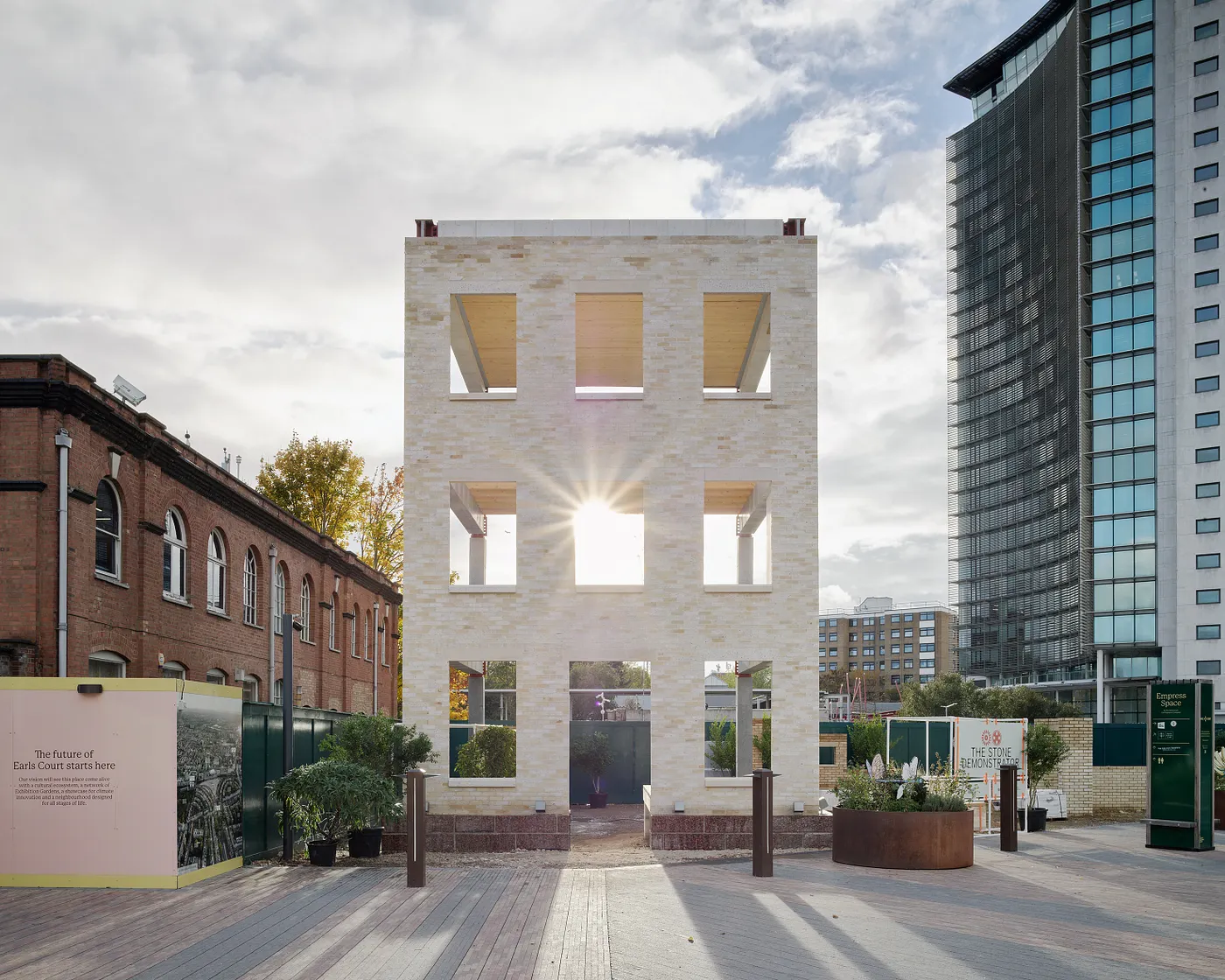
Photo: Bas Princen. Courtesy of the Design Museum and Future Observatory.
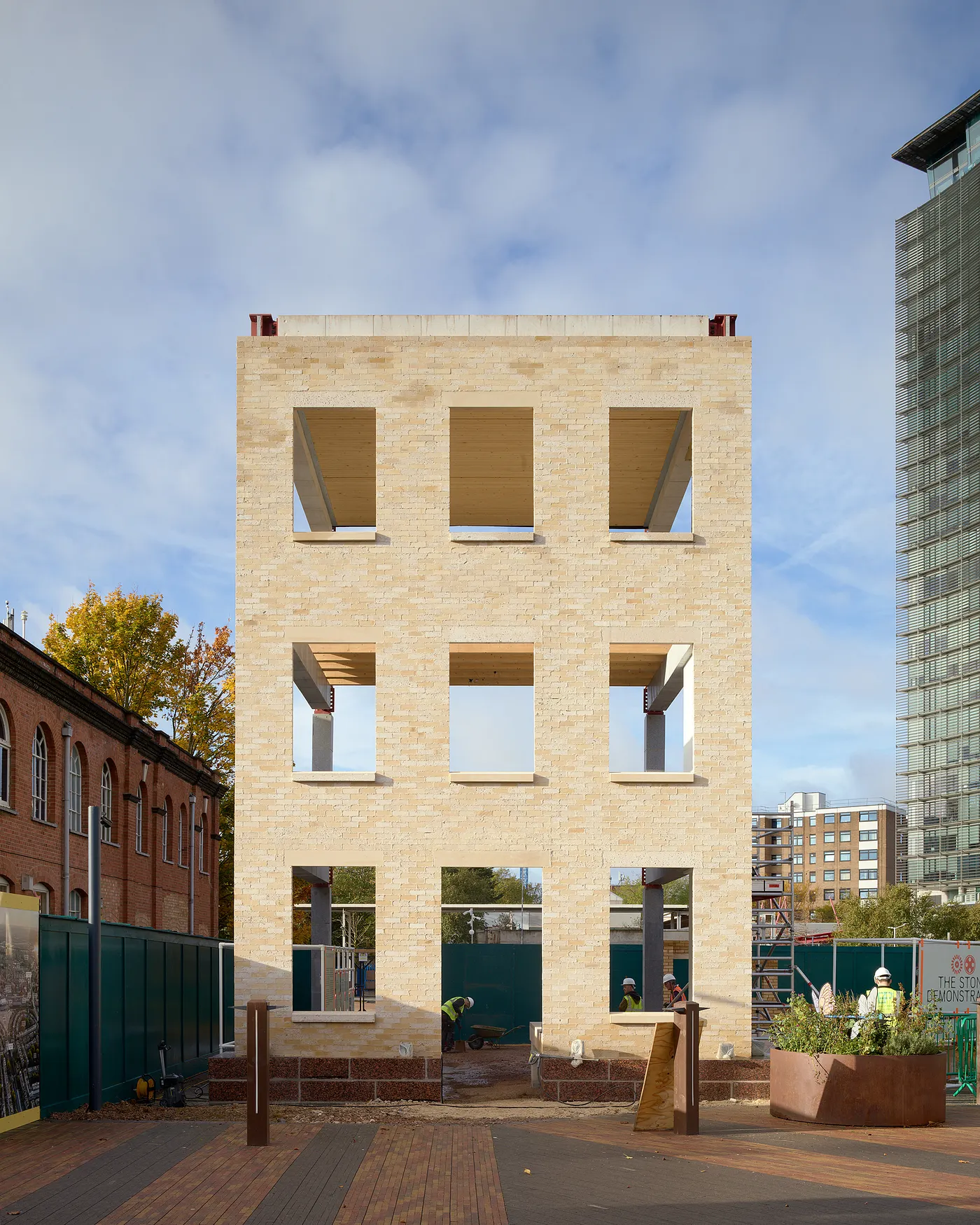
In the UK, stone appears on buildings primarily as a finish, cladding applied after the real structure, in concrete or steel, has already been built. The Stone Demonstrator, which opened in October 2025 at Empress Space on London’s Earls Court development site, is a public installation that tests a different proposition: that natural stone can carry structural loads with a fraction of the embodied carbon of conventional framing systems.
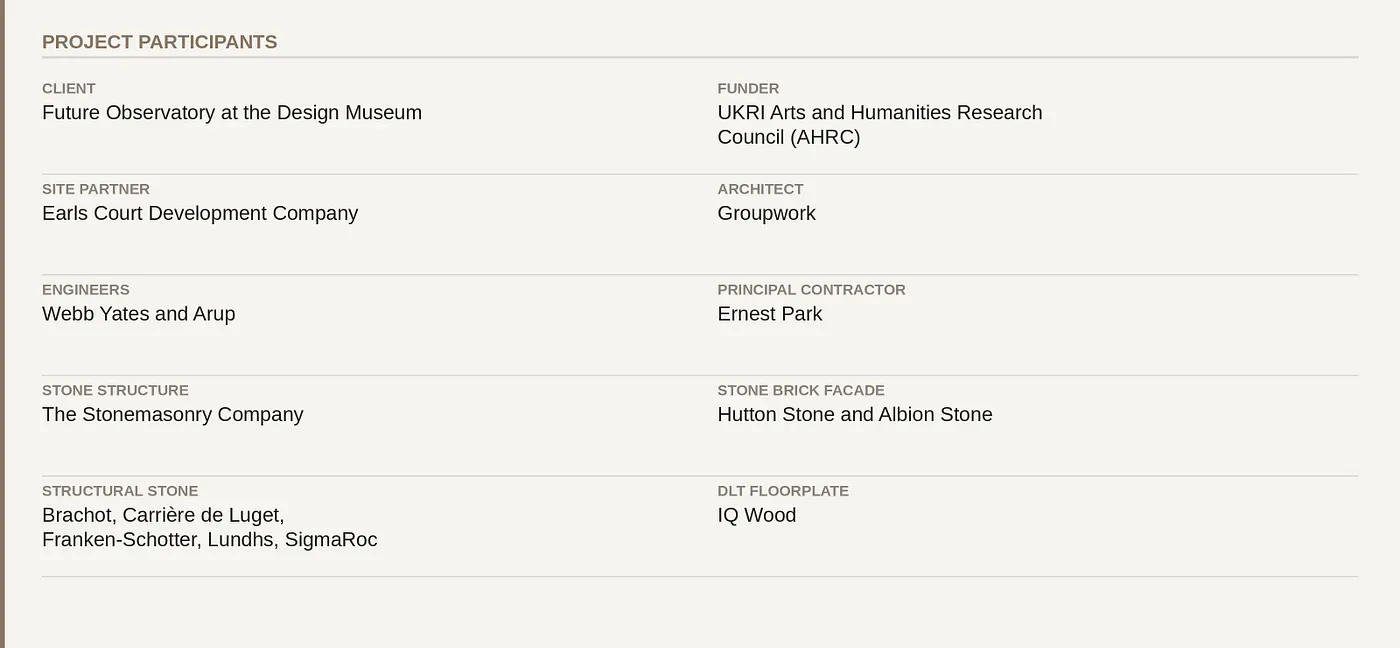
Hutton Stone contributed the natural stone brick facade to the project alongside Albion Stone. The demonstrator was designed by architecture practice Groupwork with engineers Webb Yates and Arup, and was funded by Future Observatory (the Design Museum’s national green transition research programme) and the UKRI Arts and Humanities Research Council (AHRC).
Why Stone, and Why Now?
Construction accounts for 11% of global carbon emissions from new buildings alone, according to the World Green Building Council. The majority comes from steel and concrete production. With the UK government targeting 1.5 million new homes, the pressure to find credible lower-carbon alternatives to these materials is significant.
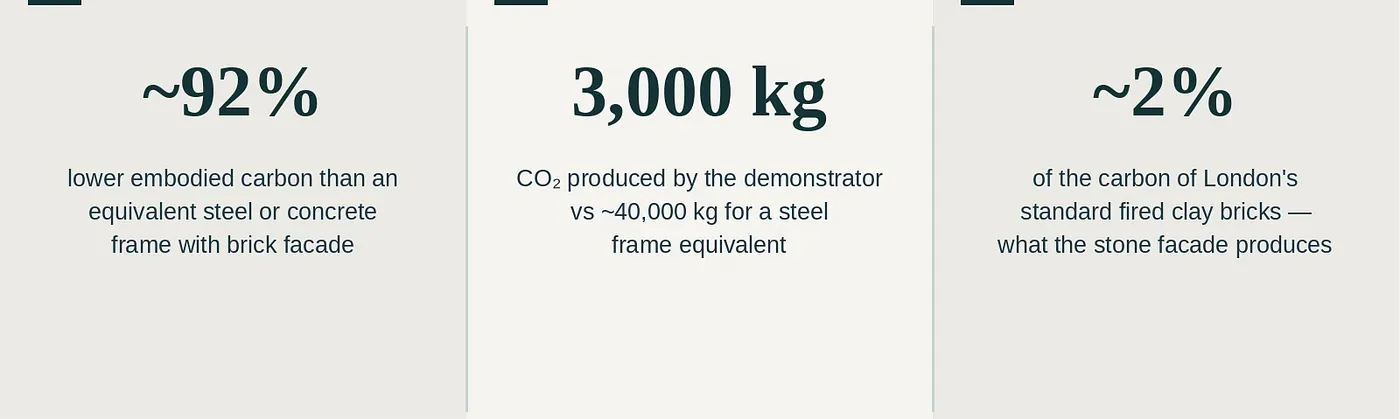
Natural stone requires far less energy to produce than concrete or steel. The Stone Demonstrator puts that advantage in quantifiable terms: the entire structure produces roughly 3,000 kg of CO₂, compared to approximately 32,000 kg for a reinforced concrete equivalent and around 40,000 kg for a steel frame with clay brick façade, each clad identically.
How the Structure Works
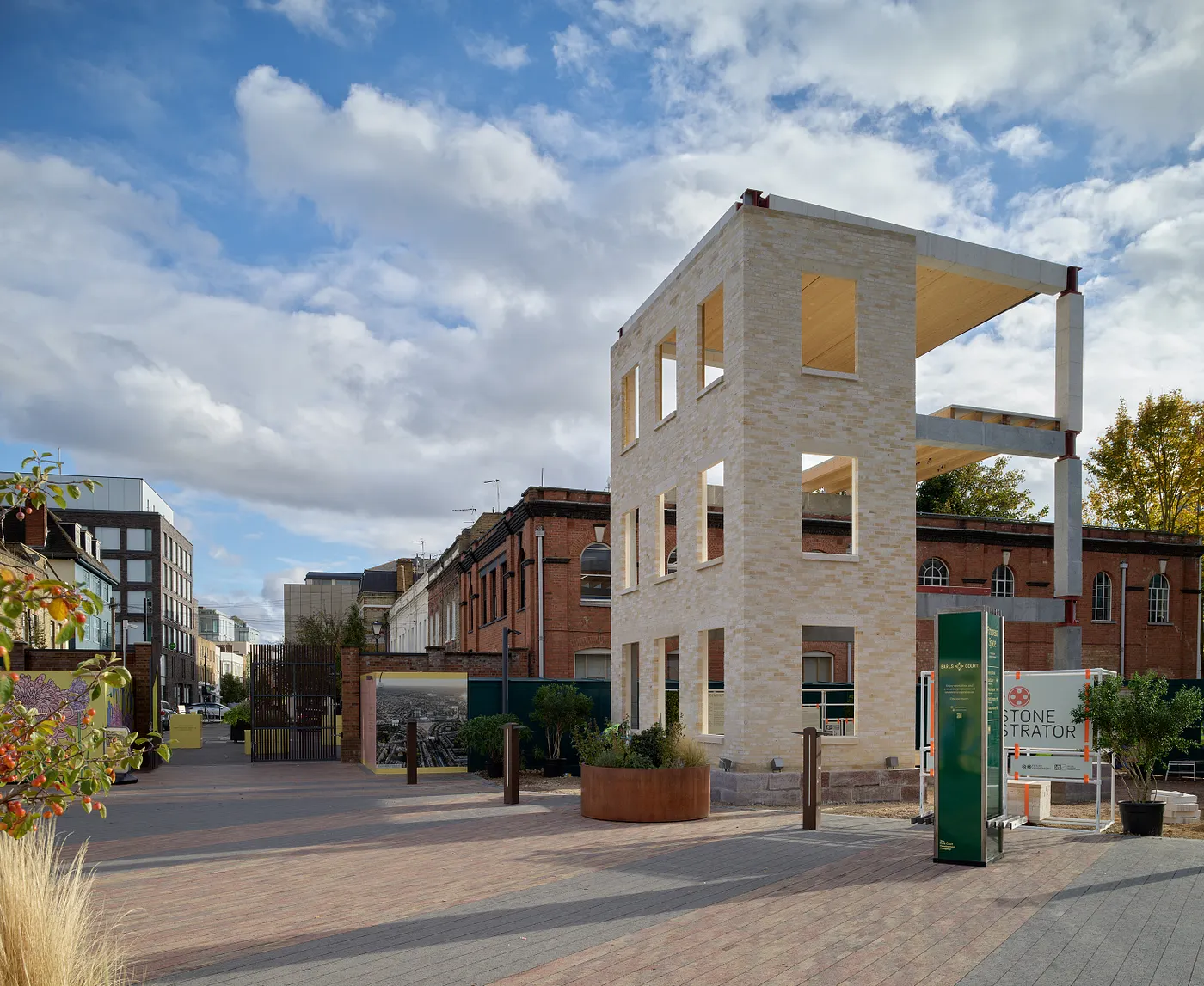
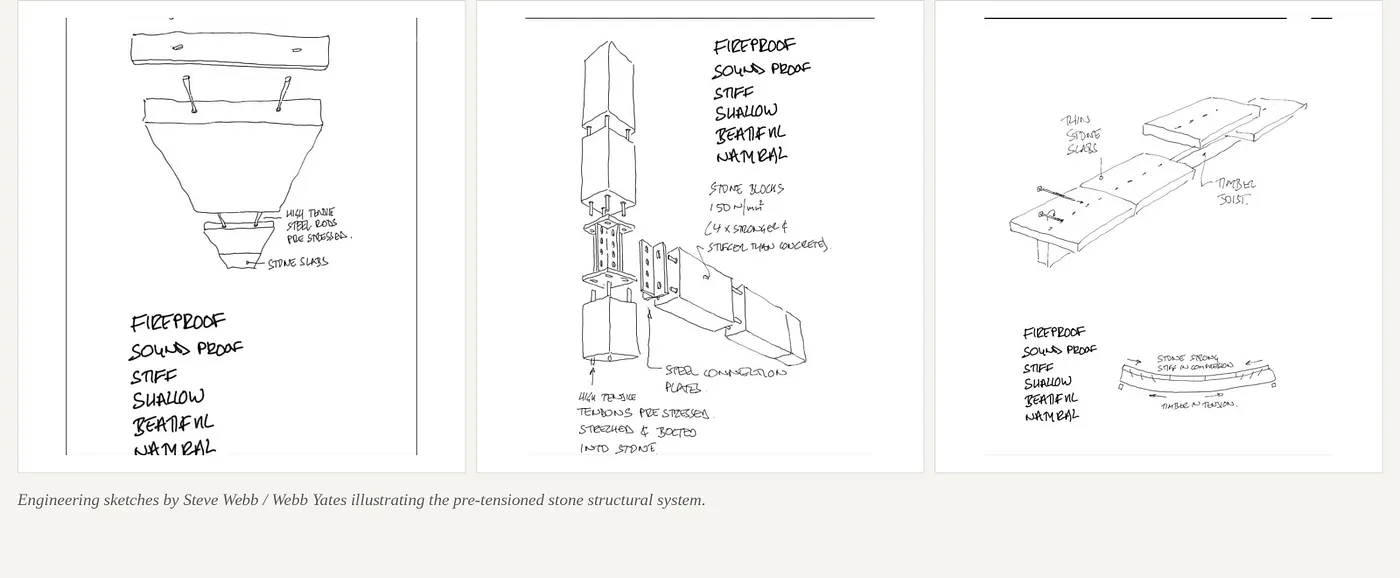
The beams and columns of the demonstrator are made from natural stone blocks threaded with high-tensile steel tendons and compressed together offsite to create pre-tensioned structural elements. These are then craned into position on site. The floorplates combine pre-tensioned stone slabs with timber joists, and the roof uses dowel-laminated timber (DLT), held together by dowels rather than glue.
 Its purpose is not to promote stone for sentimental reasons but as an ultra-low-carbon alternative to reinforced concrete and steel structures clad in fired clay bricks.
— Amin Taha, Founder and Chairman, Groupwork
Its purpose is not to promote stone for sentimental reasons but as an ultra-low-carbon alternative to reinforced concrete and steel structures clad in fired clay bricks.
— Amin Taha, Founder and Chairman, Groupwork
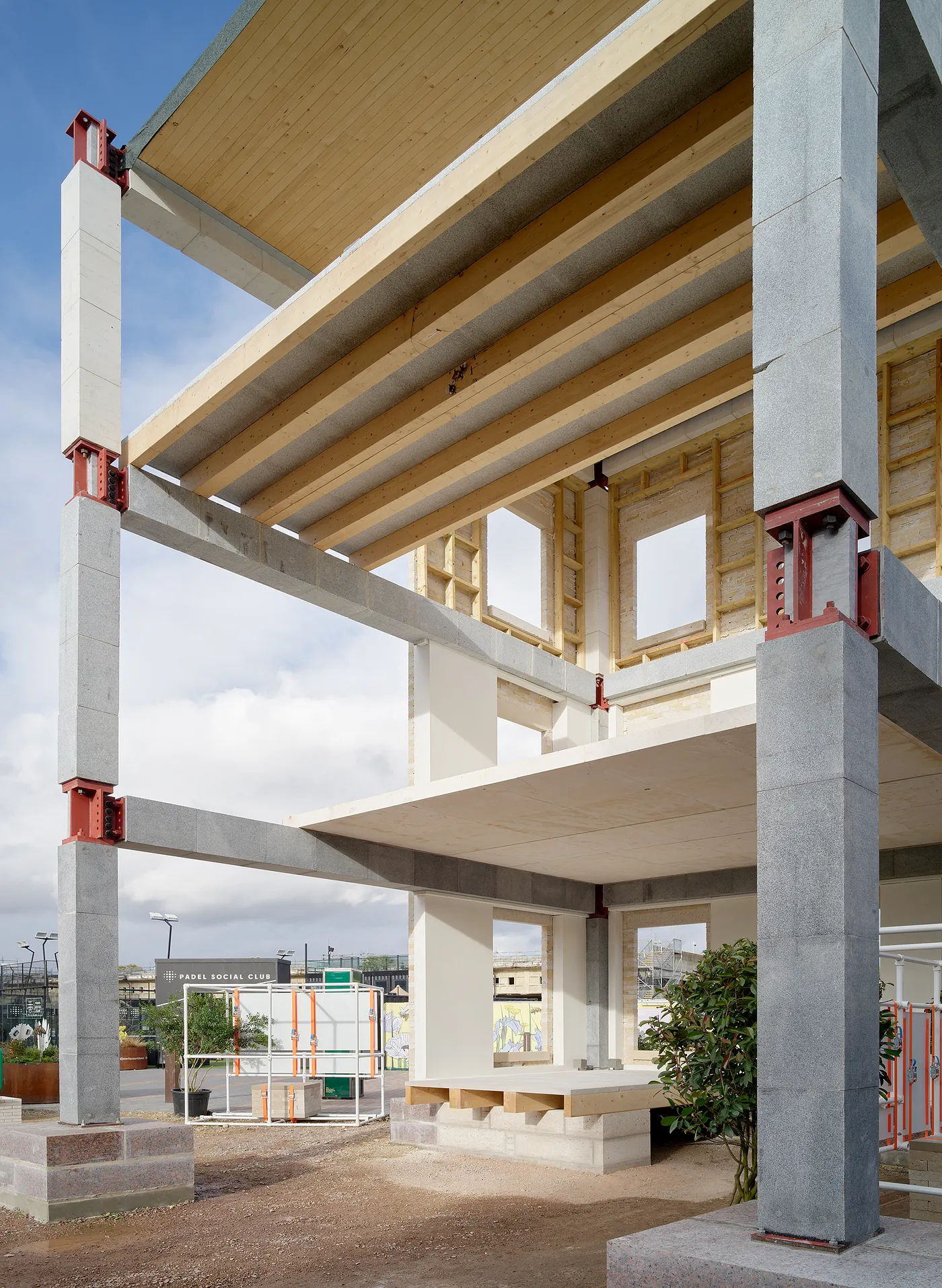
The structural interior: pre-tensioned stone columns with steel connection brackets and dowel-laminated timber roof. Photo: Bas Princen. Courtesy of the Design Museum and Future Observatory.
Hutton Stone’s Role: The Facade
Hutton Stone supplied the stone brick facade along with Albion stone, one of the most visible elements of the demonstrator, and a key part of its carbon argument. The facade is self-supporting: it carries its own weight independently from the structural frame, connected only by wind-posts set within the frame. At standard brick dimensions, this configuration can stand six storeys without loading the superstructure, which the project’s technical notes indicate reduces the overall building load and associated material and cost by approximately 30%.
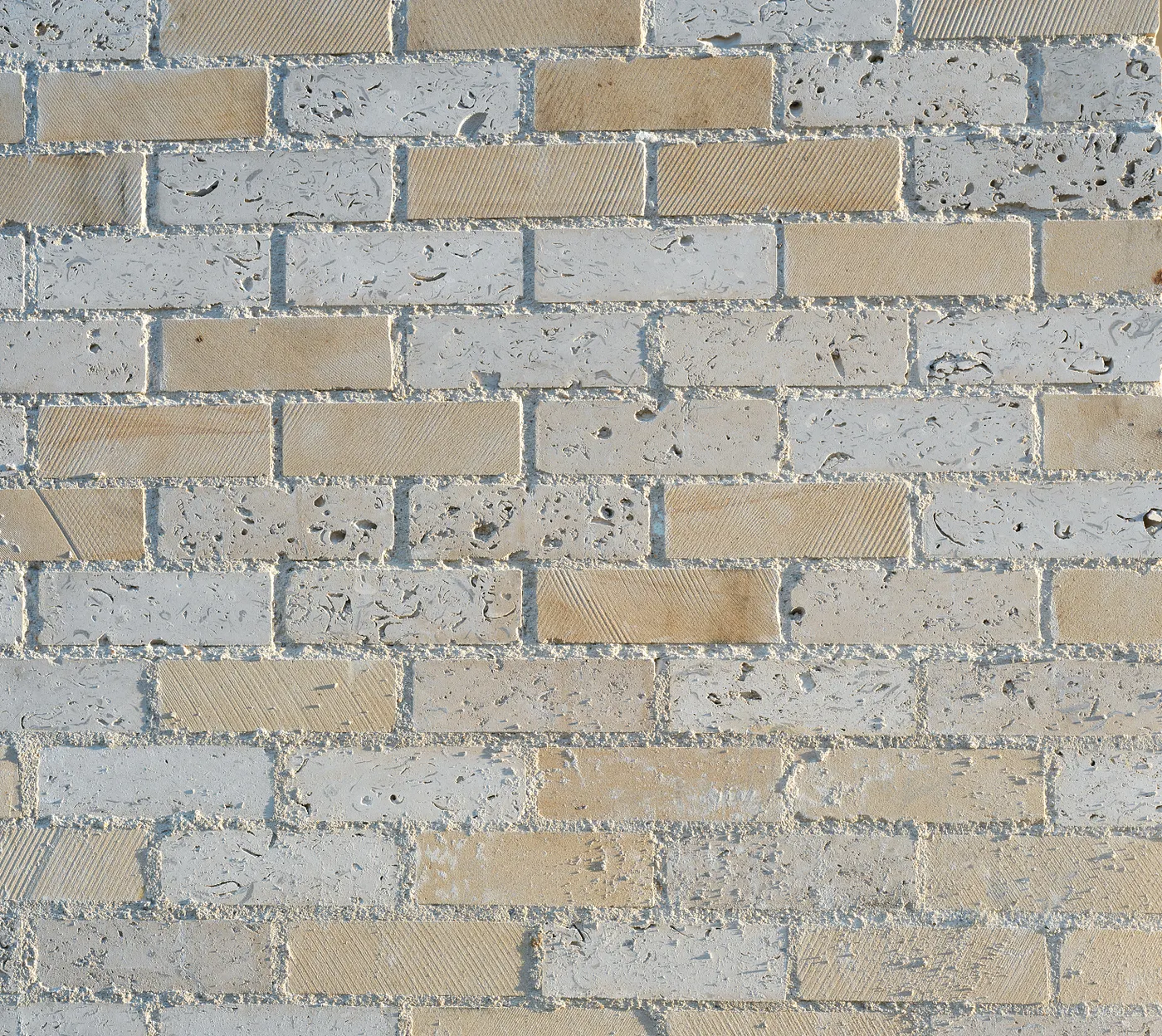
The carbon comparison with conventional brick is direct: the stone brick facade produces at least 90% less carbon than London’s standard fired clay bricks. For a construction sector trying to reduce embodied carbon across every element of a building, that kind of material-level difference matters.
The stone in this frame is produced with a fraction of the energy required to produce the alternative materials.
— Steve Webb, Board Director, Webb Yates
A 1:1 Scale Research Tool
The demonstrator is deliberately designed as a research instrument, not just a showcase. By incorporating multiple floorplate systems and facade configurations within a single structure, it gives engineers and architects something to study at real scale. The structure has been sized for office or residential use at up to ten storeys and the same structural frame type has been designed by Webb Yates and Arup for buildings up to 80 storeys in seismic areas of the Mediterranean, 30 storeys at Canary Wharf, and 35 storeys for a residential building in Bristol.
Alongside the structure, Future Observatory funded engineers at University College London led by Professor Wendel Sebastian, to develop a design guide for stone structures. A standardised guide is a prerequisite for wider industry adoption: without it, even willing project teams face significant friction when specifying unconventional structural systems.
Hutton Stone on 2050 Materials
Hutton Stone is featured on the 2050 Materials platform, where specifiers can access verified product data including EPD-backed embodied carbon figures for their range of natural stone products with sustainable properties. As the industry looks to reduce embodied carbon across every building element, having reliable, comparable data for materials like natural stone is increasingly important for early-stage design decisions.
Sources & Credits
All facts and data in this article are drawn directly from the Stone Demonstrator press release issued by Future Observatory at the Design Museum. The 11% global carbon figure is sourced from the World Green Building Council, as cited in the press release. Photography by Bas Princen; courtesy of the Design Museum and Future Observatory. Engineering drawings by Steve Webb / Webb Yates.
Related articles
H.G. Matthews: Beyond the EPD
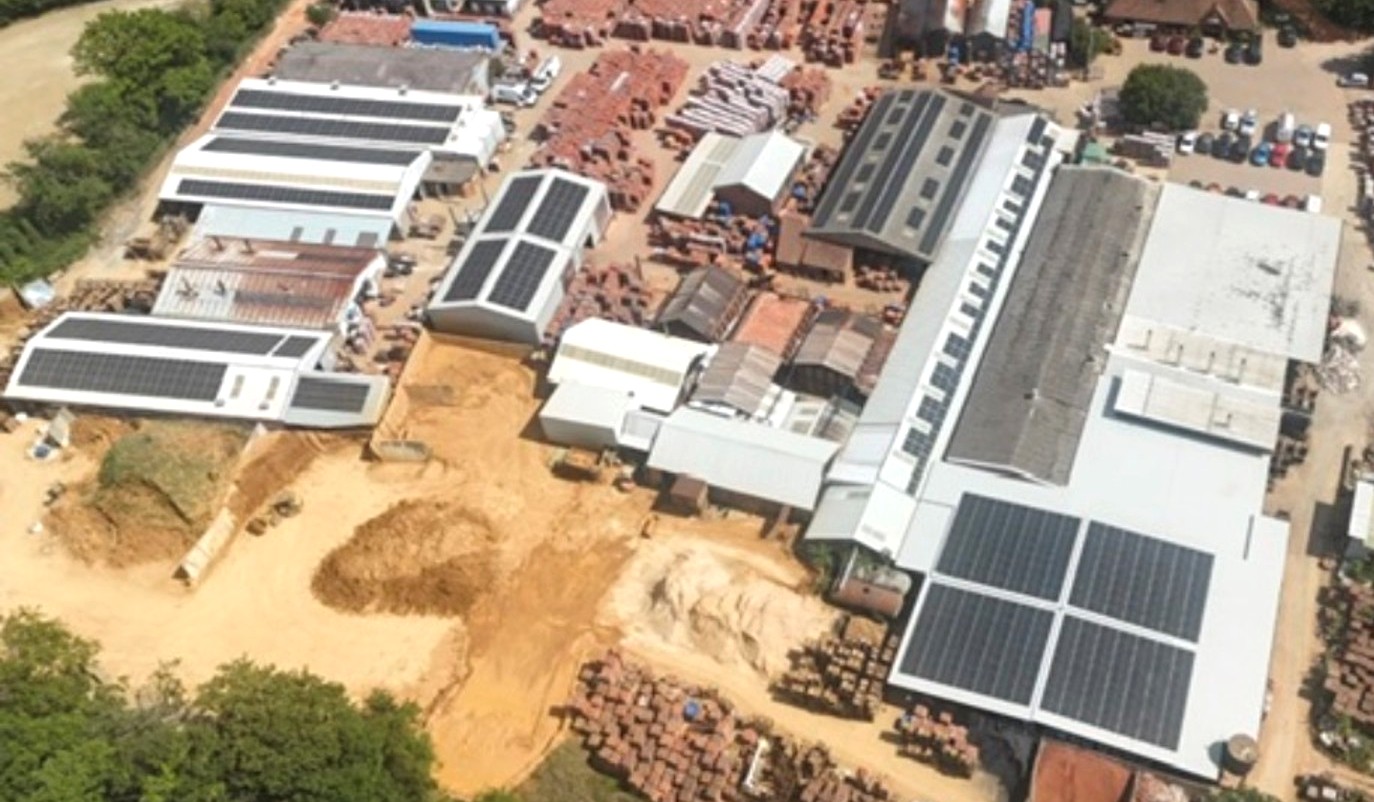
H.G. Matthews' new solar-biomass energy system at The Brickworks, Bellingdon is cutting diesel use and lowering embodied carbon, the latest step in a track record of measurable, verified environmental improvement backed by published EPDs.
Read more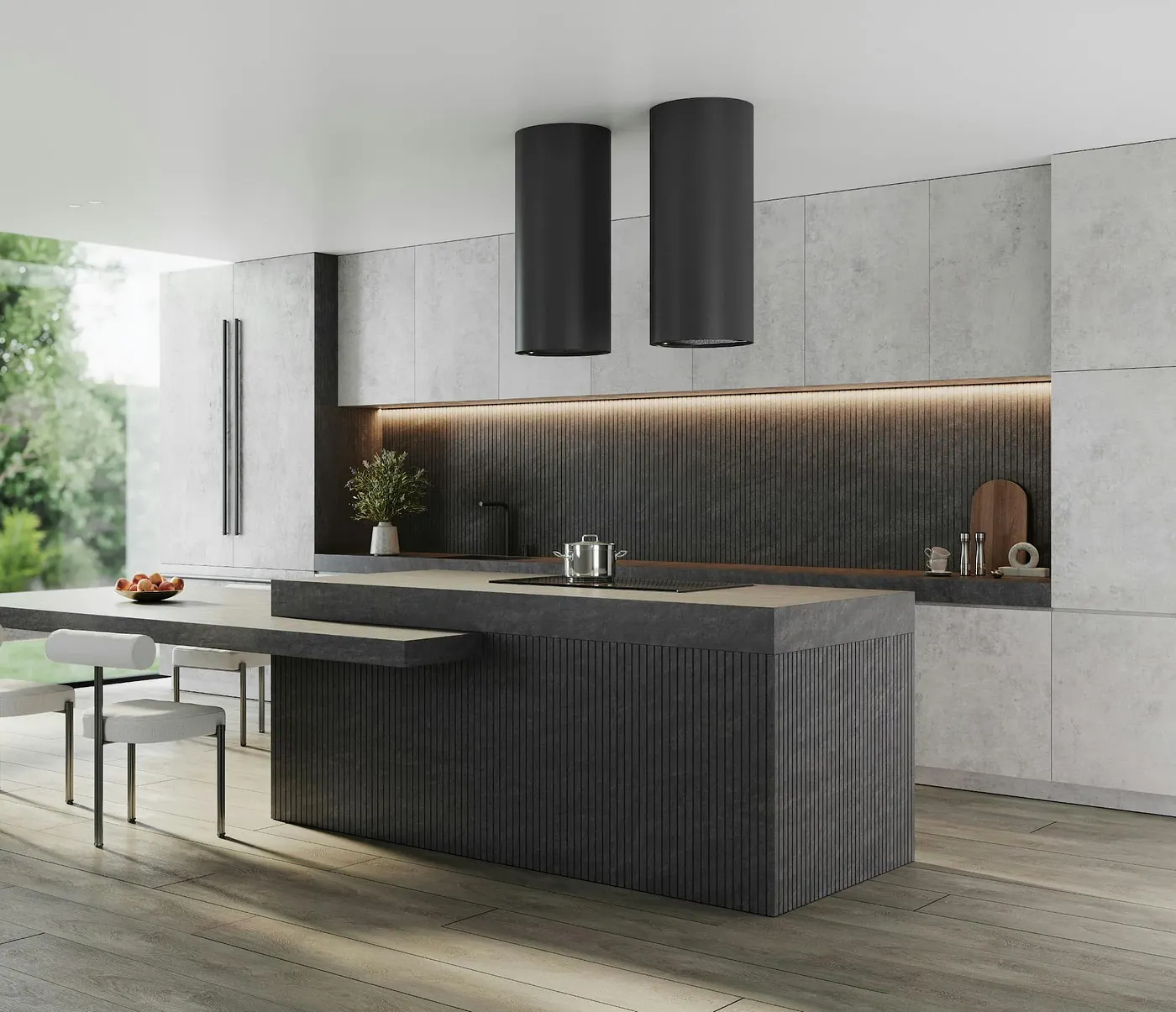
The 2026 Surface Revolution: A Global Briefing
Bans, tariffs, and billion-dollar verdicts are reshaping the surfacing industry. Here's what designers and fabricators need to know about the 2026 shift away from high-silica engineered stone.
Read more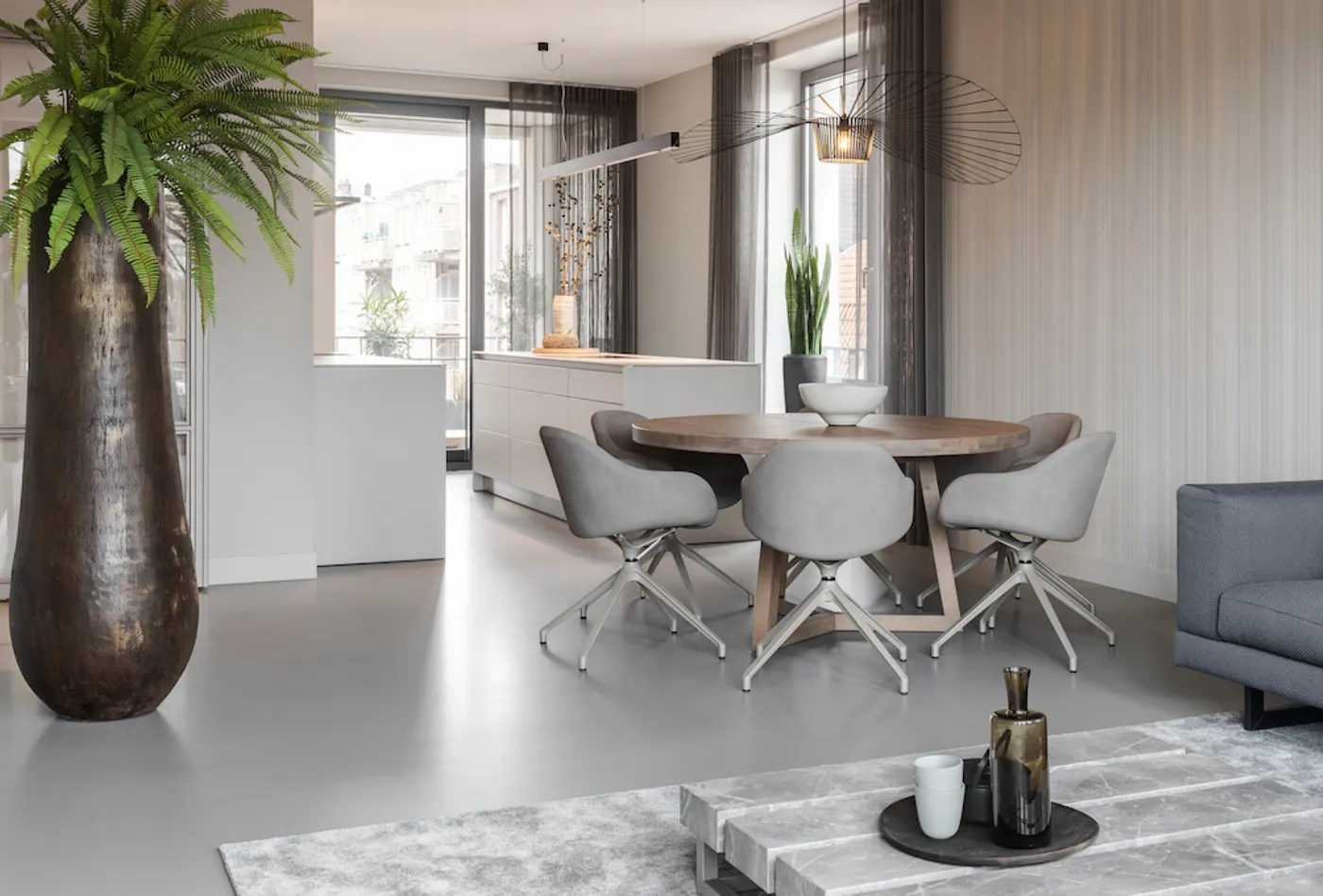
The Senso Six: Seamless Surfaces, Circular by Design
Through a portfolio of seamless flooring systems based on biobased resins and mineral aggregates, Senso UK enables architects and contractors to deliver continuous surfaces that support both design freedom and responsible material sourcing.
Read more