The Data Center Boom: Why Sustainable Construction Must Keep Pace with Digital Demand
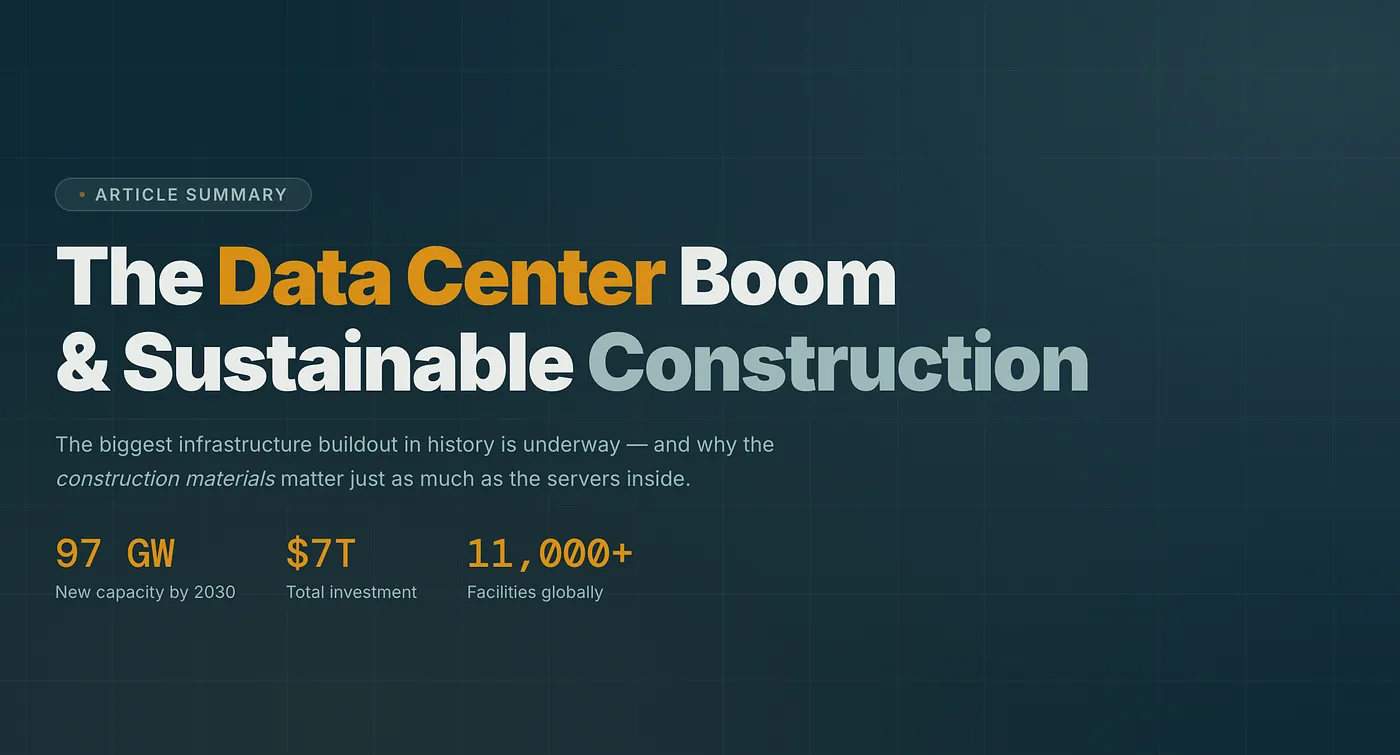
As the world races to build the infrastructure behind AI and cloud computing, the construction industry faces an unprecedented challenge and opportunity to rethink how these massive facilities are designed and built.
What you’ll find in this article: The global data center boom is accelerating fast and the construction industry needs to keep up sustainably. This piece unpacks the scale of digital infrastructure investment through 2030, examines the often-overlooked role of embodied carbon in data center construction (beyond just operational energy), and reviews how industry leaders like AWS, Google, Microsoft, Meta, and Equinix are taking action. It also makes the case for why EPD-verified material data is essential for responsible building at scale and where 2050 Materials fits into that workflow.
The Scale of What’s Coming
The numbers behind the global data center expansion are staggering. The sector is projected to add roughly 97 GW of new capacity between 2025 and 2030, effectively doubling its total footprint within five years. By the end of the decade, global data center capacity could reach approximately 200 GW, driven largely by hyperscale cloud expansion and accelerating demand for artificial intelligence (JLL 2026 Global Data Center Outlook).
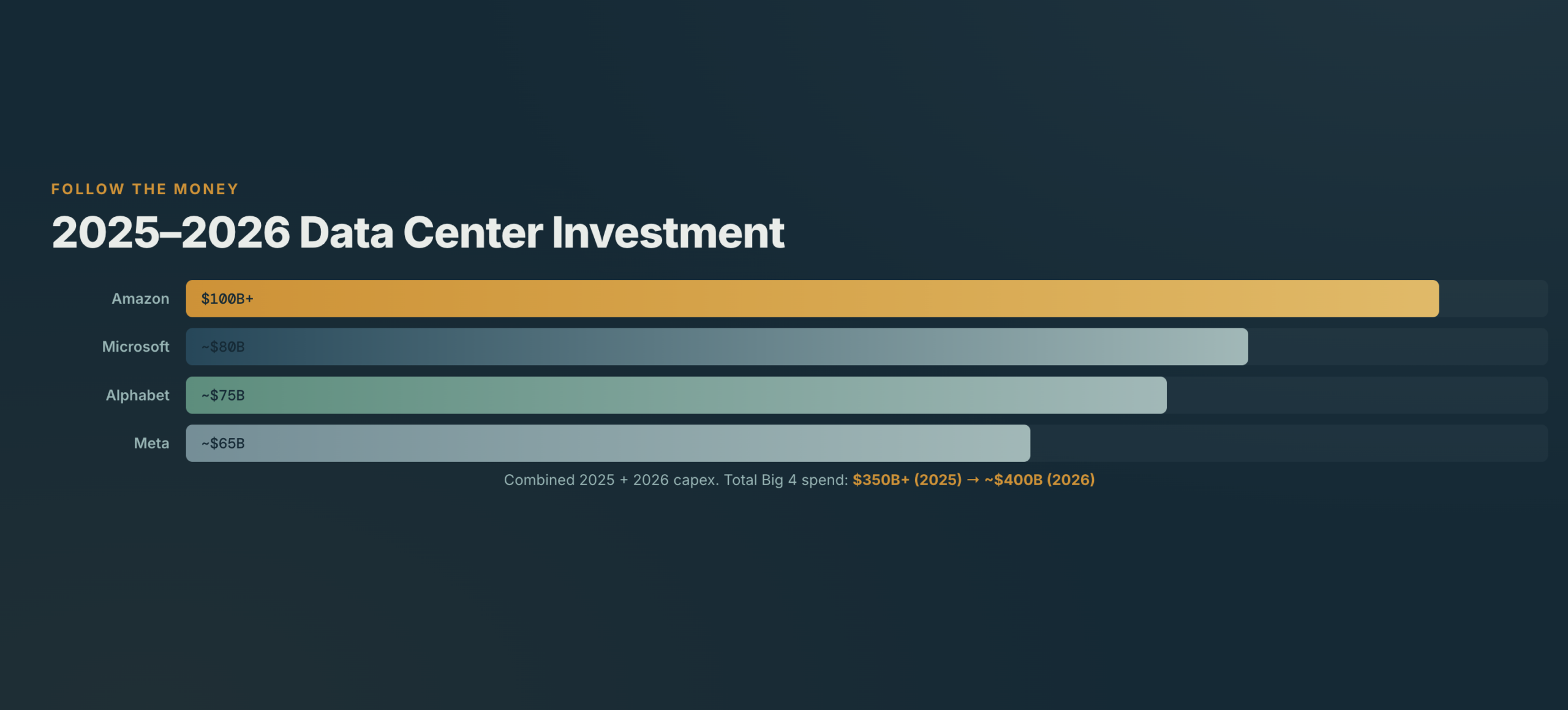
To put this in perspective, there are currently over 11,000 data centers globally spread across 174 countries, with the United States alone hosting more than 4,000 facilities as of early 2026 (Programs.com). Between now and 2030, companies worldwide are expected to invest nearly $7 trillion in building and upgrading data center infrastructure. Alphabet, Amazon, Microsoft, and Meta alone plan to invest over $350 billion in data centers in 2025 and approximately $400 billion in 2026 (Avid Solutions).
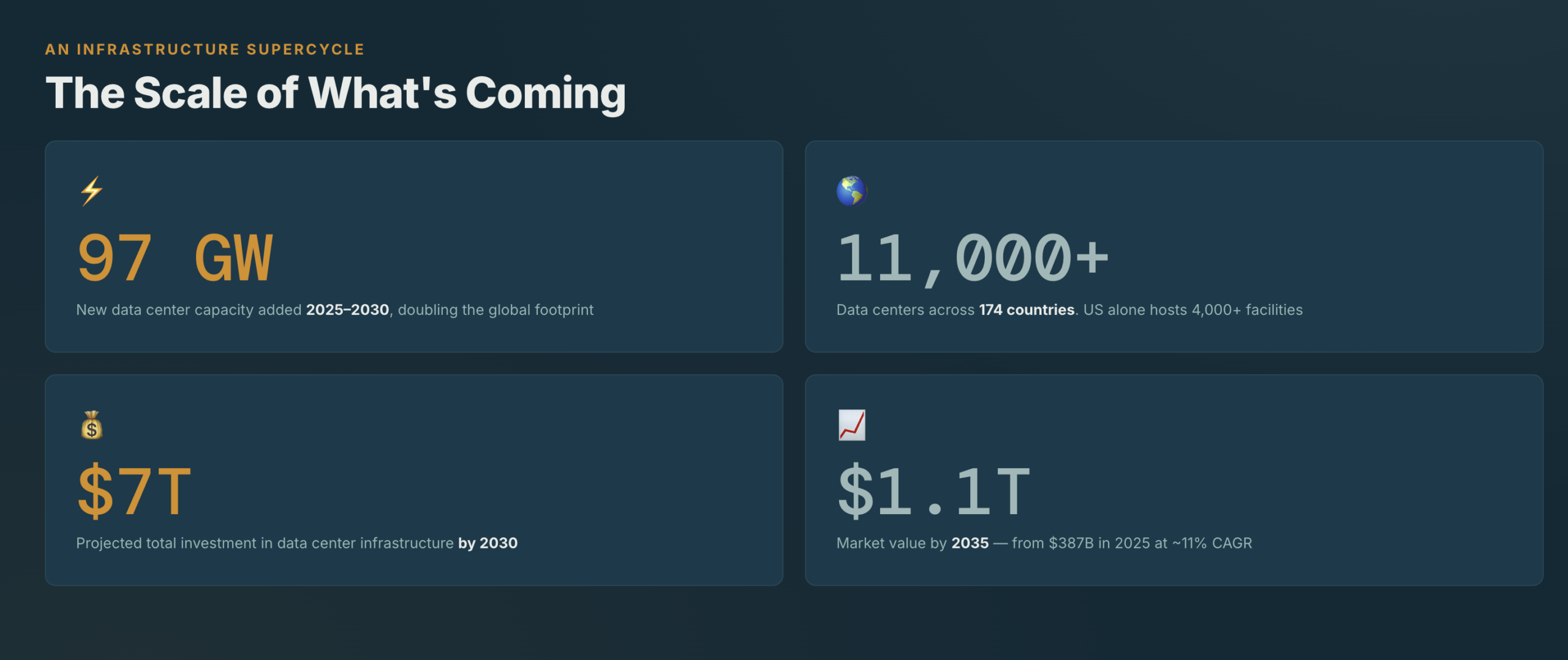
The market tells a similar story. The global data center market, valued at approximately $387 billion in 2025, is projected to exceed $1.1 trillion by 2035, growing at a compound annual growth rate of around 11% (Precedence Research).
This is not a trend that will slow down. It is an infrastructure supercycle and it carries profound implications for the construction industry and the planet.
The Environmental Footprint: More Than Just Energy Bills
Much of the public conversation around data center sustainability focuses on operational energy the electricity consumed by servers, storage, and cooling systems. And the numbers are significant: data centers consumed around 415 terawatt-hours (TWh) of electricity globally in 2024, representing roughly 1.5% of total global electricity consumption. By 2030, the International Energy Agency (IEA) projects this figure could double to approximately 945 TWh (IEA Energy and AI Report, 2025).
In the United States alone, data centers consumed 183 TWh in 2024 more than 4% of the country’s total electricity use and roughly equivalent to the annual electricity demand of Pakistan. By 2030, this could grow to 426 TWh (Pew Research Center).
Water consumption presents another critical dimension. The IEA projects that the data center industry’s water consumption will rise from approximately 560 million cubic meters in 2023 to 1.2 billion cubic meters by 2030 — equivalent to the annual consumption of a city of roughly 7.5 million people (S&P Global). A medium-sized data center can consume up to 110 million gallons of water annually for cooling, equivalent to roughly 1,000 households. Larger facilities can use up to 5 million gallons per day (EESI).
But there is a critical and often overlooked component of data center sustainability: embodied carbon.
The Hidden Carbon Cost: Embodied Emissions in Data Center Construction
Embodied carbon encompasses all the greenhouse gas emissions generated during the extraction, manufacturing, transportation, and installation of building materials. For data centers which consume vast quantities of concrete, steel, and sophisticated mechanical, electrical, and plumbing (MEP) systems, this represents a significant and growing share of their total environmental impact.
According to the U.S. Environmental Protection Agency (EPA), data centers accounted for around 1% of global greenhouse gas emissions as of 2023, though other estimates place the figure between 2.5% and 3.5%, with projections suggesting it could climb to 8% by 2030 (GRESB).
Concrete and steel are the two most significant contributors to embodied carbon in data center construction. Concrete can account for as much as 40% of the total material used in a data center build, while steel both reinforcement and structural can make up approximately 10%. Cement alone is responsible for roughly 90% of the embodied carbon in concrete. On average, producing a ton of cement generates approximately 1.25 tons of CO₂ (Schneider Electric; DCD).
The iMasons Climate Accord, a coalition of over 70 companies including the largest data center operators has recognized that embodied carbon is a material and growing component of data center emissions that must be addressed alongside operational efficiency. Their guidance emphasizes that whole-building Life Cycle Assessments (LCAs) for data centers must extend beyond the building envelope to include site infrastructure and equipment-intensive systems (iMasons Climate Accord).
As electricity grids continue to decarbonize through the adoption of renewable energy, embodied carbon will represent an increasingly larger proportion of a data center’s total lifecycle emissions. This makes the construction phase one of the most critical levers for near-term emissions reduction within the digital infrastructure sector.
What the Industry Leaders Are Doing
Amazon Web Services (AWS): Scaling Low-Carbon Construction
AWS has been at the forefront of incorporating lower-carbon materials into data center construction. The company reports having 43 data centers globally that were constructed using either or both lower-carbon concrete and steel more than double its previously reported total. In a recent reporting period, AWS achieved savings of more than 22,000 tons of CO₂ equivalent from 27 data centers using these materials (AWS Sustainability).
AWS has demonstrated that by replacing 40% of ordinary cement with slag in concrete mixes, embodied carbon in the cement mix can be reduced by over 30%. The company has also achieved weight reductions of 70 tons of steel per two-story data center by incorporating higher-strength structural steel, which delivers the same performance with less material. Additionally, by removing concrete toppings from mezzanine floors and using only steel beams, each facility saves roughly 115 metric tons of CO₂ equivalent.
Google: Efficiency Leadership and Clean Energy at Scale
Google operates some of the most energy-efficient data centers in the world, reporting a fleet-wide Power Usage Effectiveness (PUE) of 1.09 in 2024 compared with the industry average of 1.56. This means Google data centers use approximately 84% less overhead energy per unit of IT equipment energy than a typical facility (Google Data Centers).
In 2024, the company reduced its data center energy emissions by 12% compared to 2023, even as data center electricity consumption increased by 27% year-over-year due to AI-driven growth. Google signed contracts to purchase over 8 GW of clean energy generation in 2024 the largest annual total in its history and has signed the world’s first corporate agreement for nuclear energy from small modular reactors (SMRs) (Google 2025 Environmental Report).
On embodied carbon, Google is working to reduce greenhouse gas emissions from construction by minimizing material quantities and using more sustainable alternatives such as green concrete and renewable diesel. Its “central fleet” program which reallocates and reuses existing computing resources avoided procurement of new components with an embodied impact equivalent to approximately 260,000 metric tons of CO₂e in 2024 (Google Cloud Blog).
Microsoft: Carbon Negative by 2030
Microsoft has set some of the most ambitious sustainability targets in the industry, aiming to be carbon negative, water positive, and zero waste by 2030. From 2023 to 2027, the company plans to expand its European cloud capacity by 40%, with over 200 data centers operating across Europe by the end of 2026 (Microsoft Source EMEA).
A cornerstone of Microsoft’s approach is circularity. In 2024, the company achieved a 90.9% reuse and recycling rate for servers and components exceeding its 2025 target a year early. Microsoft operates eight Circular Centers worldwide that recover and repurpose data center components. Additionally, the company is exploring innovative data center designs that consume zero water for cooling, potentially avoiding an estimated 125,000 cubic meters of water consumption annually per facility (Microsoft 2025 Sustainability Report).
Microsoft is also committed to reducing embodied carbon in building materials, chips, and fuels, and has pledged to reduce overall data center water use by 40% by 2030.
Meta: Pioneering Mass Timber and Low-Carbon Concrete
Meta is taking a distinctive approach to reducing embodied carbon in its data center construction. The company began piloting mass timber in data center campus construction in 2025, starting with an administration building at its Aiken Data Center in South Carolina. Mass timber engineered wood products that substitute for steel and concrete can reduce the embodied carbon of substituted materials by approximately 41% in administrative buildings (Meta Sustainability).
Meta is also deploying concrete with significantly lower embodied carbon by substituting cement with alternatives like fly ash and slag, and investing in AI-optimized concrete formulas to further reduce emissions at scale. The company has joined the iMasons Climate Accord and RMI’s Coordinated Corporate Action on Low-Emissions Concrete initiative, linking companies across the supply chain to take collective action (Meta Low Carbon Concrete).
On the hardware side, Meta has developed a detailed methodology for estimating embodied carbon at the component level across its entire server fleet down to individual screws enabling more precise identification of reduction opportunities (Meta Embodied Carbon Research).
Equinix: A Three-Pillar Embodied Carbon Strategy
Equinix, the world’s largest colocation data center operator with over 270 facilities across 76 markets, has organized its approach to embodied carbon around three pillars: avoid using new materials whenever possible, reduce the embodied carbon of materials that cannot be avoided, and innovate to explore emerging technologies. The company achieved a 30% embodied carbon reduction in a London facility, demonstrating a scalable approach across its global portfolio (Equinix Blog).
The Reuse Advantage: Why Repurposing Beats New Construction
One of the most powerful strategies for reducing embodied carbon is avoiding new construction entirely. Research from Serverfarm, analyzed by design firm HKS, found that modernizing and repurposing an existing building for data center use eliminated an estimated 88% of the embodied carbon emissions compared to new construction. The study examined an existing six-story data center in Chicago and determined that building reuse eliminates embodied carbon equivalent to the operational carbon of 200 server cabinets operating for a year (Schneider Electric).
Constructing a new facility creates approximately eight times more carbon than upgrading or repurposing an existing data center, making adaptive reuse a critical decarbonization strategy.
Furthermore, extending server lifespans by just one additional year can reduce cumulative data center embodied carbon by approximately 16% (Schneider Electric Scope 3).
Why EPDs and Data Are the Foundation of Sustainable Data Center Construction
Environmental Product Declarations (EPDs) serve as the backbone of informed material selection in any construction project, but they are especially critical in data center builds where material volumes are enormous and the stakes are high.
An EPD is a standardized, third-party-verified document that quantifies the environmental impact of a product across its lifecycle from raw material extraction through manufacturing, transport, use, and end-of-life. For data center construction, EPDs provide the granular, product-level data needed to compare alternatives and make procurement decisions that meaningfully reduce embodied carbon.
The data center industry is increasingly recognizing this. The iMasons Climate Accord is working to adopt standardized methodologies for measuring carbon in digital infrastructure, relying on EPDs and LCA data as foundational inputs. AWS, Meta, Google, and others are all actively specifying lower-carbon materials based on verified environmental data.
However, the challenge remains one of access, comparability, and scale. With tens of thousands of construction products used in a typical data center build from structural steel and concrete to insulation, cladding, MEP systems, and IT hardware manually sourcing and comparing EPD data is impractical.
Where 2050 Materials Fits In
This is precisely the challenge that 2050 Materials was built to solve.
2050 Materials provides the construction industry’s largest database of sustainability data related to building materials, with a free-to-access web platform hosting over 182,475 products populated with data from Environmental Product Declarations (EPDs) and other certifications. For data center developers, architects, and construction professionals navigating the complexity of sustainable material selection, this is a transformative resource.
The platform allows users to:
- Discover and compare building materials based on verified environmental data, including total CO₂e, biogenic CO₂e, manufacturing emissions (A1-A3), end-of-life impacts (C1, C3, C4), and circularity metrics.
- Generate carbon reports using the Whole Life Cycle Assessment (WLCA) tool, enabling teams to assess project alignment with industry benchmarks and climate targets.
- Filter and sort by region, product type, and sustainability performance, ensuring locally sourced, low-carbon options are identified quickly.
- Access data via API for seamless integration into existing digital design workflows, BIM processes, and cost estimation tools like CostX.
For data center projects where material standardization is common and designs are replicated across multiple facilities establishing low-carbon specifications on the 2050 Materials platform once means they can be efficiently scaled across future builds. This aligns directly with the industry best practice identified by Schneider Electric: once low-carbon practices are established at one facility, they should be easy to replicate.
The Road Ahead: Building Digital Infrastructure Responsibly
The data center construction boom is not optional it is the physical foundation upon which the AI revolution, cloud computing, and the next generation of digital services will be built. The question is not whether we build, but how we build.
The industry is at a critical inflection point. As operational energy emissions are increasingly addressed through renewable energy procurement and efficiency gains, embodied carbon in construction materials and hardware is becoming the dominant share of a data center’s lifecycle emissions. Addressing this requires a fundamental shift in how construction materials are specified, sourced, and evaluated.
The good news is that the tools, data, and industry momentum already exist. EPDs provide the verified data. Platforms like 2050 Materials provide the access, comparison, and workflow integration needed to act on that data at scale. And the world’s largest technology companies are demonstrating that low-carbon construction is not just feasible it is becoming a competitive imperative.
For architects, engineers, developers, and procurement professionals involved in data center construction, the message is clear: sustainability data must be embedded into every stage of the design and construction process, from site selection through material specification and beyond.
Start exploring sustainable building materials for your next data center project on 2050 Materials →
Sources & Further Reading
- JLL — 2026 Global Data Center Outlook: jll.com/data-center-outlook
- Programs.com — Measuring the Data Center Boom: Facts and Statistics (2026): programs.com/data-center-statistics
- Avid Solutions — 13 Data Center Growth Projections That Will Shape 2026–2030: avidsolutionsinc.com
- Precedence Research — Data Center Market Size, Share, and Trends 2026 to 2035: precedenceresearch.com
- IEA — Energy and AI Report, 2025: iea.org/reports/energy-and-ai
- Pew Research Center — US Data Centers’ Energy Use Amid the AI Boom: pewresearch.org
- S&P Global — Beneath the Surface: Water Stress in Data Centers: spglobal.com
- EESI — Data Centers and Water Consumption: eesi.org
- GRESB — Understanding Embodied and Operational Carbon in Data Centers: gresb.com
- Schneider Electric — Addressing the Hidden Challenge of Embodied Carbon in Data Centers: blog.se.com
- Schneider Electric — Demystifying Data Center Scope 3 Carbon: blog.se.com
- DCD — Sustainable Data Centers Require Sustainable Construction: datacenterdynamics.com
- iMasons Climate Accord — Best Practices for Data Center LCAs: climateaccord.org
- AWS — How AWS Is Using More Lower-Carbon Materials: aboutamazon.com
- Google — Operating Sustainably: datacenters.google
- Google — 2025 Environmental Report: sustainability.google
- Google Cloud Blog — Carbon-Aware Data Center: cloud.google.com
- Microsoft — Building the Future: How Datacenters Are Innovating with Sustainability in Mind: news.microsoft.com
- Microsoft — 2025 Sustainability Report: datacentremagazine.com
- Meta — Data Center Sustainability: sustainability.atmeta.com
- Meta — Advancing Low Carbon Concrete in Our Data Centers: sustainability.atmeta.com
- Meta — Estimating Embodied Carbon in Data Center Hardware: sustainability.atmeta.com
- Equinix — Embodied Carbon: The Unseen Emissions: blog.equinix.com
- Clarity.ai — Data Center Emissions Are Rising. Are Firms Doing Enough?: clarity.ai
- World Economic Forum — How Data Centres Can Avoid Doubling Their Energy Use by 2030: weforum.org
- Data Centre Magazine — Building the Next Generation of Green Data Centres: datacentremagazine.com
- IEEE Spectrum — Data Center Sustainability Metrics: Hidden Emissions: spectrum.ieee.org
- EU Energy — In Focus: Data Centres — An Energy-Hungry Challenge: energy.ec.europa.eu
Related articles
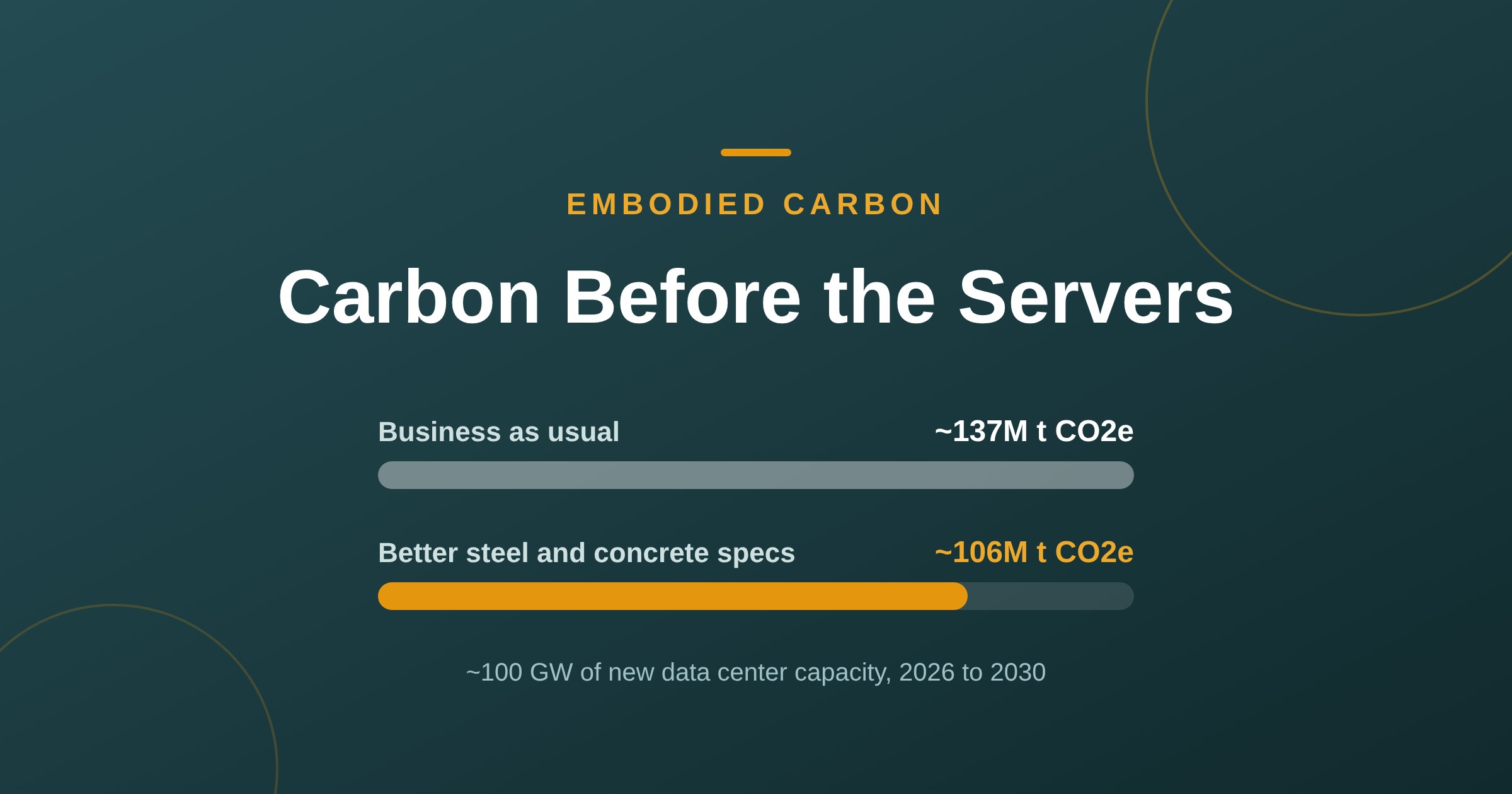
Data Centers’ Hidden 137M-Tonne Carbon Bill
New data centers could lock in ~137M tonnes of CO2e before a single server switches on. GGBS concrete and recycled steel could cut about 31M of it.
Read more
Built to Beat the Heat
This summer's drought wasn't a fluke, it was a preview. Here's the material data that actually decides whether a building shrugs off a heatwave or quietly cooks behind a great winter U value: decrement delay, solar reflectance, SHGC, and the real products behind each one.
Read more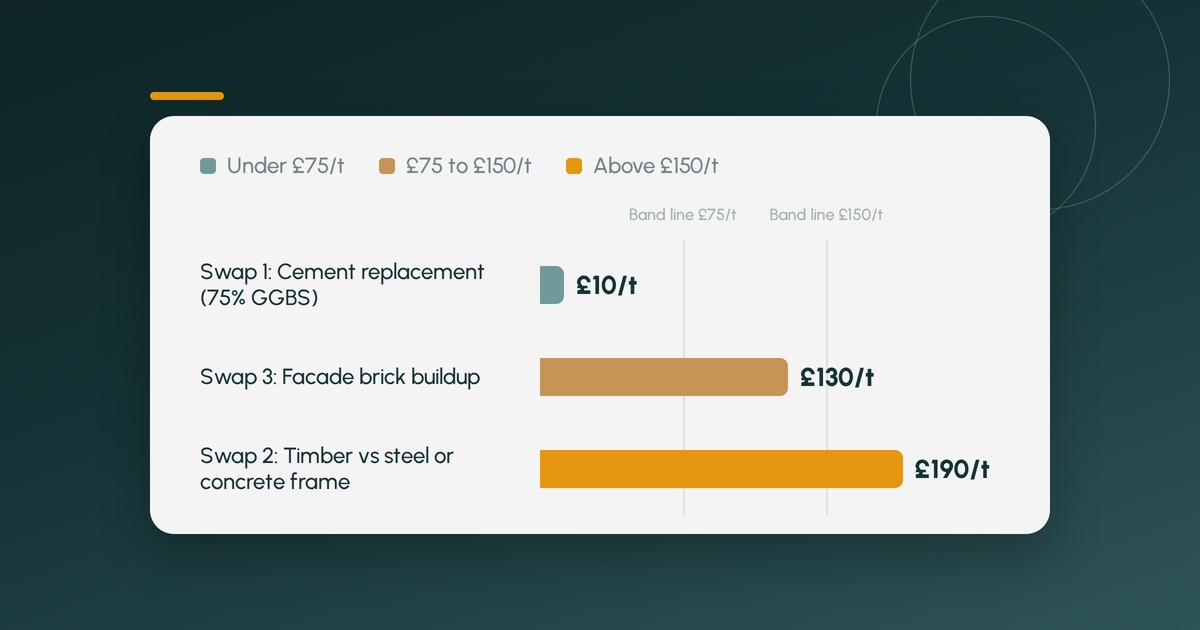
The Cost per Tonne Test for Embodied Carbon Swaps
Not every embodied carbon cut is worth paying for. Test any swap on cost per tonne of CO2e, see which band it falls in, and try the free calculator.
Read more