
Climate-Resilient Materials for the Built Environment: A Data-Centred Prime

1. Why “resilience attributes” now sit beside carbon metrics
- Recorded global temperatures are already +1.55 °C above pre-industrial levels and trending toward 3 °C by 2100, driving more frequent cyclones, wildfires, floods, and heat waves.
- Annual adaptation spending must rise from ≈ $76 billion today to $0.5–1.3 trillion by 2030, with a significant share flowing to infrastructure and materials.
- For project teams this means that embodied-carbon optimisation alone is insufficient; material choices must also buffer specific physical hazards over the asset life.
2. A systems lens on material resilience
Inputs → Material formulation (chemistry, micro-structure)
Constraints → Building codes, cost tolerances, embodied-carbon budgets
Feedback loops → Performance under hazard events → repair frequency → lifetime emissions & cost
Failure modes → Structural collapse, façade ignition, moisture ingress, thermal stress
A balanced specification therefore minimises total lifecycle risk-adjusted cost:
f = CAPEX
  + Expected Damage(hazard × material)
  + Carbon Price × CO₂e
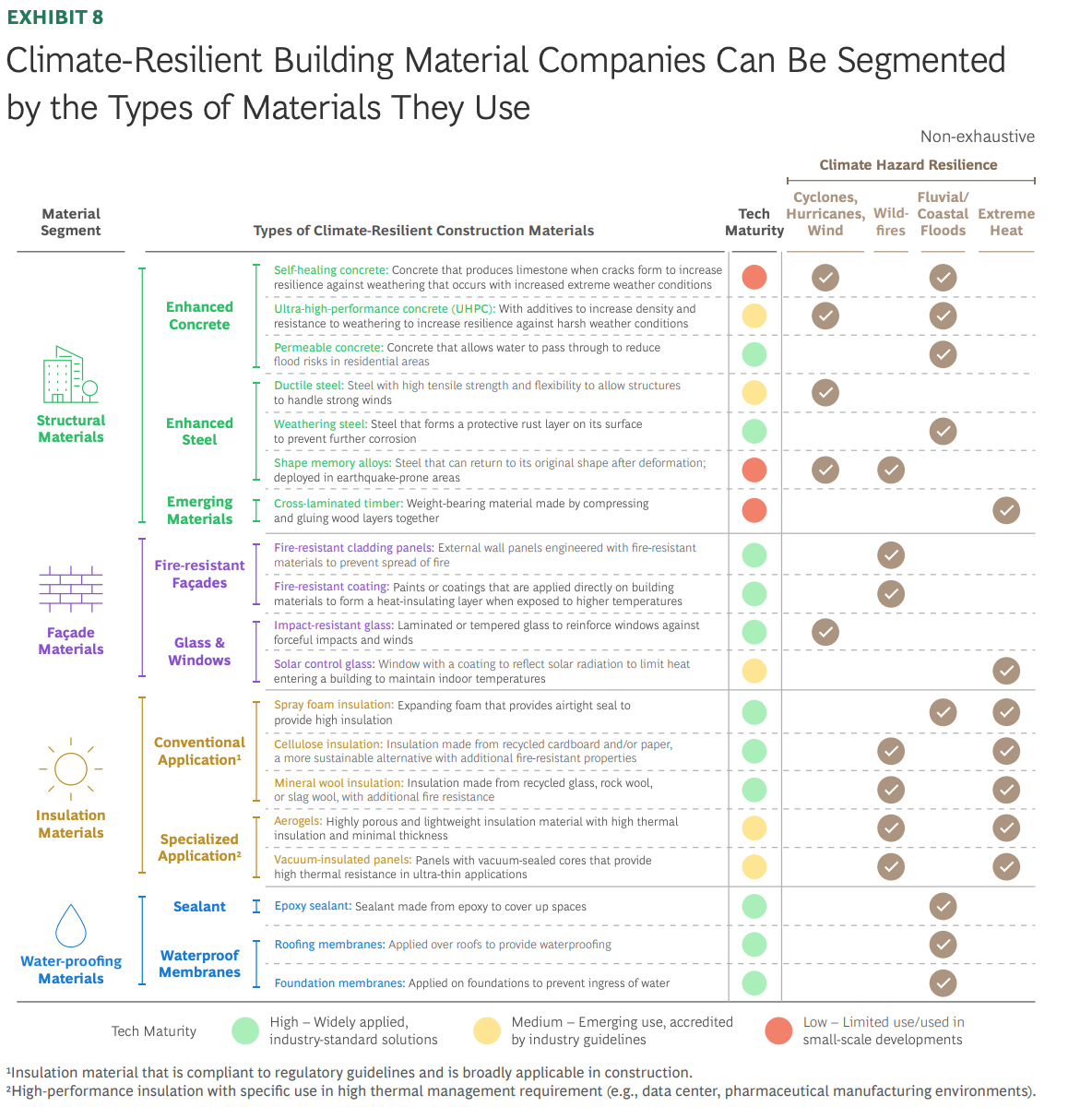
3. Taxonomy of climate-resilient materials
| Segment | Sub-class | Core mechanism | Principal hazards mitigated | Tech maturity |
|---|---|---|---|---|
| Structural | Self-healing concrete | Autogenic/bacterial CaCO₃ formation seals cracks | Wind-driven rain, freeze–thaw cycling | Medium |
| Ultra-high-performance concrete (UHPC) | Dense matrix & steel fibres resist impact | Hurricanes, debris impact, wildfires (heat spalling) | Medium | |
| Permeable concrete | Open pore network allows drainage | Fluvial & pluvial floods | High | |
| Ductile steel | High elongation before fracture | Cyclonic wind, seismic action | High | |
| Weathering steel | Stable oxide layer slows corrosion | Salt-spray coastal zones | High | |
| Shape-memory alloys | Phase change restores shape | Earthquakes, blast | Low | |
| Cross-laminated timber (CLT) | Orthogonal lamellae improve load path | Seismic & wind; paired with fire coatings | Medium | |
| Façade | Fire-resistant cladding panels | Mineral cores delay flashover | Wildfires, external fires | Medium |
| Fire-resistant coatings | Intumescent layer forms thermal char | Wildfires | Medium | |
| Impact-resistant glass | Laminated/tempered layers absorb energy | Wind-borne debris | High | |
| Solar-control glass | Low-e or spectrally selective coatings | Extreme heat, glare | High | |
| Insulation | Spray foam | Closed-cell expansion blocks air | Heat, minor wind-driven rain | High |
| Cellulose | Recycled fibres plus fire retardant | Heat, moderate fire | High | |
| Mineral wool | Basalt/glass fibres withstand >1000 °C | Wildfire & heat | High | |
| Aerogels | Nano-porous silica, λ ≈ 0.014 W/mK | Extreme heat in thin build-ups | Low | |
| Vacuum-insulated panels (VIPs) | Evacuated core cuts conduction & convection | High heat loads in constrained spaces | Low | |
| Water-proofing | Epoxy sealants | Cross-linked barrier fills gaps | Wind-driven rain, flash floods | High |
| Roofing membranes | Elastomeric sheets divert water | Intense rainfall | High | |
| Foundation membranes | Bituminous or HDPE layers stop ingress | Rising groundwater | High |
Data fields that matter
| Indicator family | Examples |
|---|---|
| Hazard-specific KPI | Crack-healing rate, permeability index, fire-resistance rating, wind-borne-debris impact level |
| Mechanical / thermal | Compressive strength, ductility ratio, λ-value, SHGC |
| Durability | Corrosion rate, UV stability, service life |
| Environmental | GWP (A1–A3), biogenic carbon, recycled content |
4. Integrating resilience data into digital design workflows
- Material-hazard mapping: 2050 Materials’ API already returns embodied-carbon datasets. By extending the schema with the KPIs above, a BIM or parametric model can filter materials based on site-specific hazard layers (e.g. FEMA flood maps, wildfire WUI zones).
- Multi-objective optimisation: Pareto-front evaluation lets practitioners visualise carbon vs repair-cost vs first-cost trade-offs in real time.
- Continuous feedback: Post-occupancy sensor data (e.g. leak detection, façade temperature) can be looped back to update performance priors, refining future specifications.
5. Practical next steps for project teams
- Early-stage screening: During concept design, flag any structural or enclosure component lacking at least one material option that meets the dominant local hazard.
- Declarative specifications: Require suppliers to provide third-party-verified resilience KPIs alongside EPDs.
- Portfolio-level benchmarking: Track the percentage of floor area protected against each hazard category and correlate with insurance premiums and carbon savings.
- R&D focus: Prioritise materials that deliver co-benefits—e.g. UHPC mixes with supplementary cementitious materials, or CLT assemblies with intumescent coatings—to avoid trading carbon for resilience.
6. Outlook
Market analysis points to 6–8 % CAGR for climate-resilient building materials, with façade and insulation solutions leading growth. As climate disclosure frameworks mature, resilience KPIs will become as standardised—and as scrutinised—as GWP today. Embedding these attributes into data platforms such as 2050 Materials is therefore not a side project but a prerequisite for credible low-carbon design in a high-risk climate.
Related articles
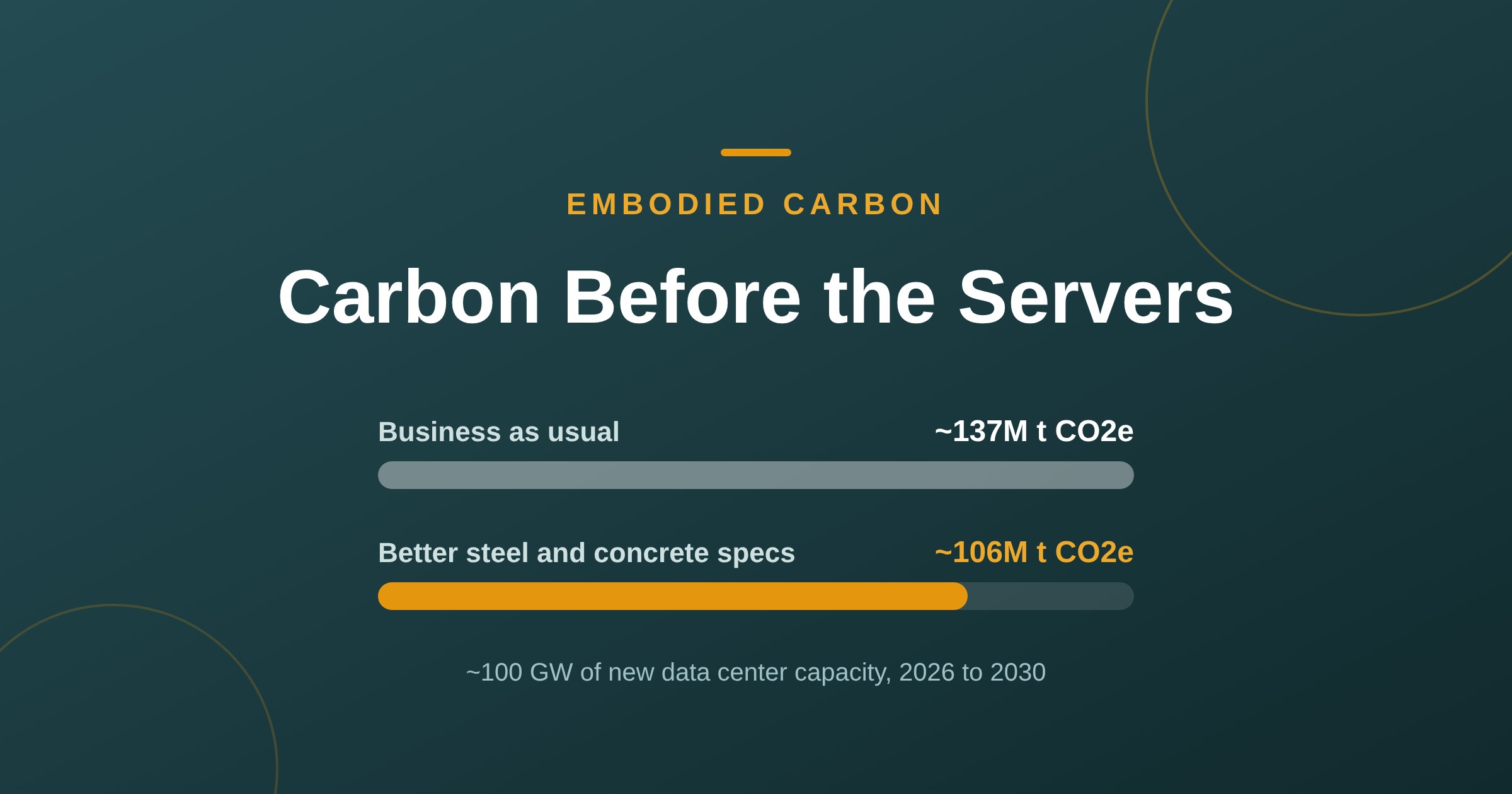
Data Centers’ Hidden 137M-Tonne Carbon Bill
New data centers could lock in ~137M tonnes of CO2e before a single server switches on. GGBS concrete and recycled steel could cut about 31M of it.
Read more
Built to Beat the Heat
This summer's drought wasn't a fluke, it was a preview. Here's the material data that actually decides whether a building shrugs off a heatwave or quietly cooks behind a great winter U value: decrement delay, solar reflectance, SHGC, and the real products behind each one.
Read more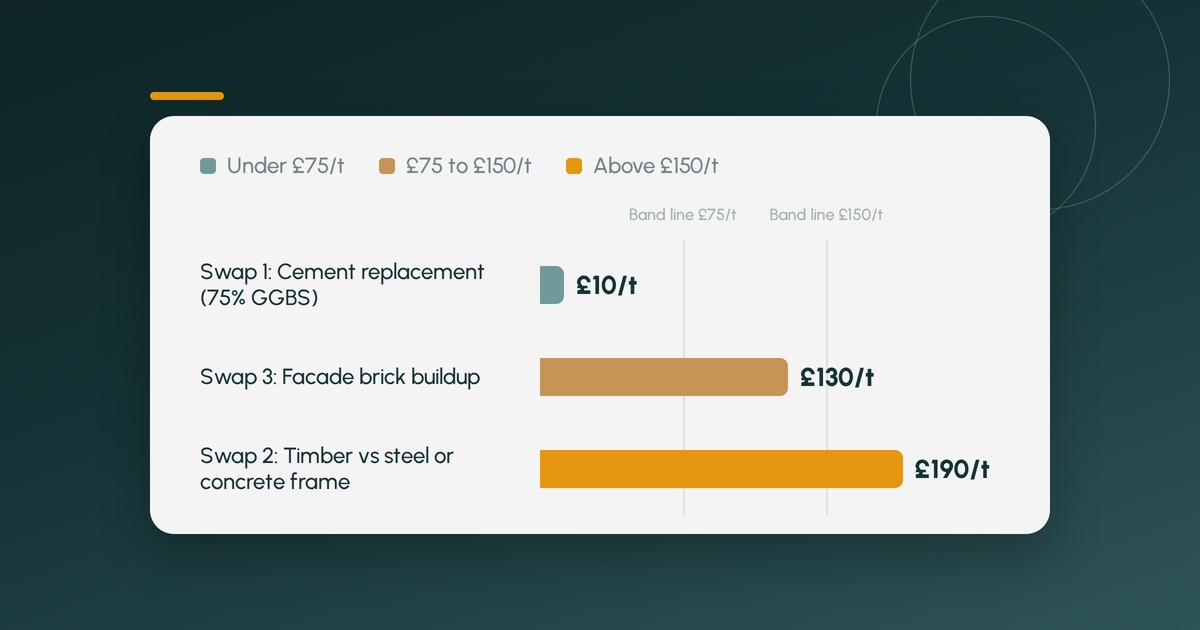
The Cost per Tonne Test for Embodied Carbon Swaps
Not every embodied carbon cut is worth paying for. Test any swap on cost per tonne of CO2e, see which band it falls in, and try the free calculator.
Read more