
How the Digital Product Passports Bring (Building) Material Passports Into Reality
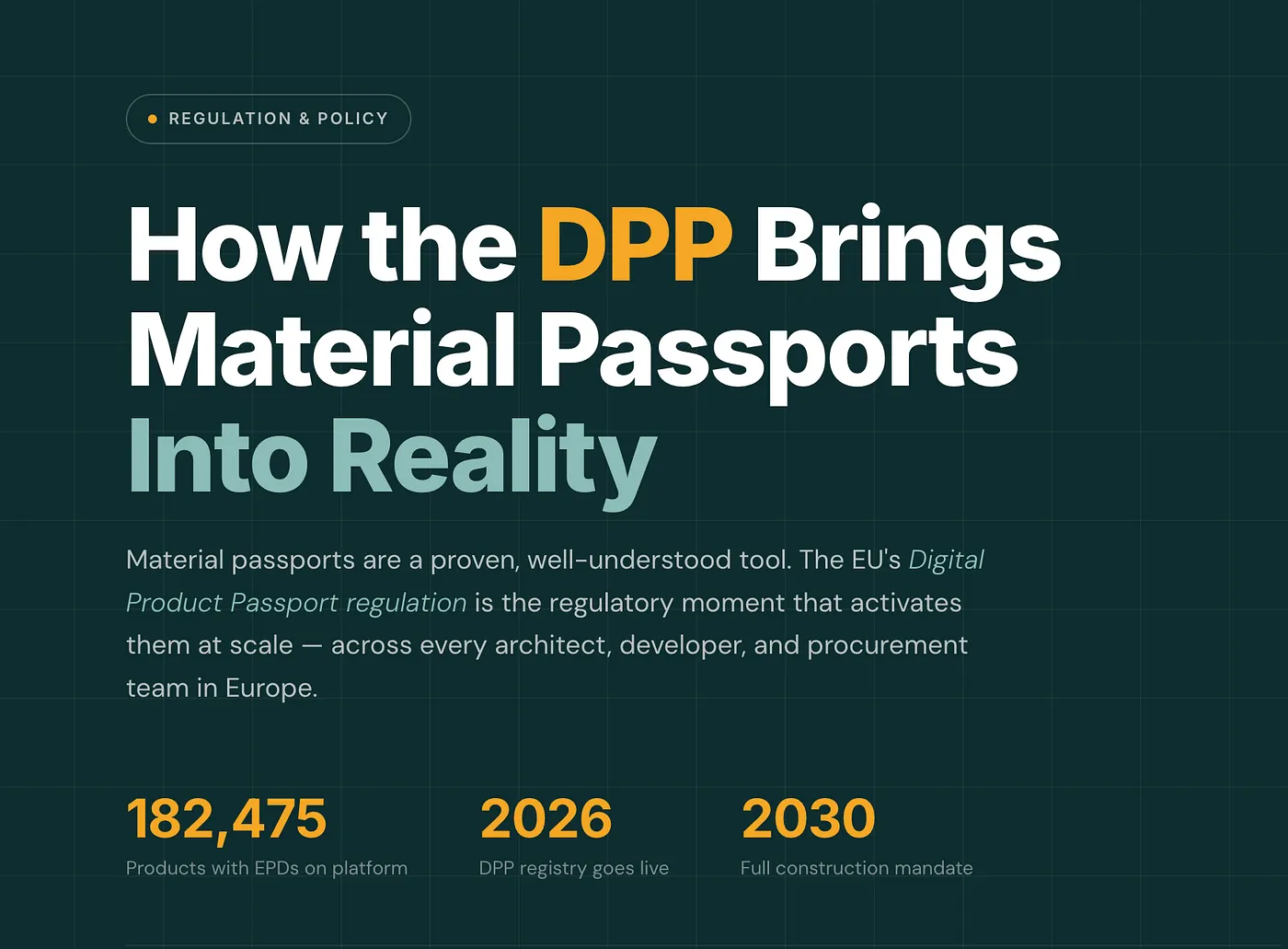
Material passports have been part of the built environment conversation since the mid-2010s. The Netherlands built pilots into major urban regeneration projects. Belgium embedded them into public procurement. Scandinavia developed frameworks. Researchers published extensively. The concept was never the question; it was clear, compelling, and correct: document every material in a building, its composition, location, embodied carbon, recycled content, disassembly potential and you transform demolition from a waste event into a resource recovery operation. A structural steel beam isn’t rubble. It’s a documented asset with a known carbon value and a verified path to reuse.
The industry knew this. It agreed with it. It just couldn’t act on it at scale, because the three conditions required for any tool to move from voluntary best practice to standard operation were all absent at once:
What Material Passports Were Waiting For
A mandate: Without a legal requirement, material passports were a flagship-project gesture. Procurement pressure and cost constraints meant they stayed optional and optional tools don’t scale in construction.
A standard: Pilots across Europe used incompatible data fields, formats, and platforms. A passport produced in Amsterdam couldn’t be read by a database in Brussels. The framework existed; the interoperability didn’t.
A consequence: There was no moment in a project’s lifecycle where the absence of a material passport cost anyone anything. No penalty, no exclusion, no commercial disadvantage. So the incentive to produce one simply wasn’t there.
The EU’s Digital Product Passport regulation provides all three simultaneously. A legal mandate across 27 member states. Standardised, machine-readable data requirements defined in law. And a market consequence with real teeth: no compliant passport, no EU market access. The tool hasn’t changed. The conditions around it have.
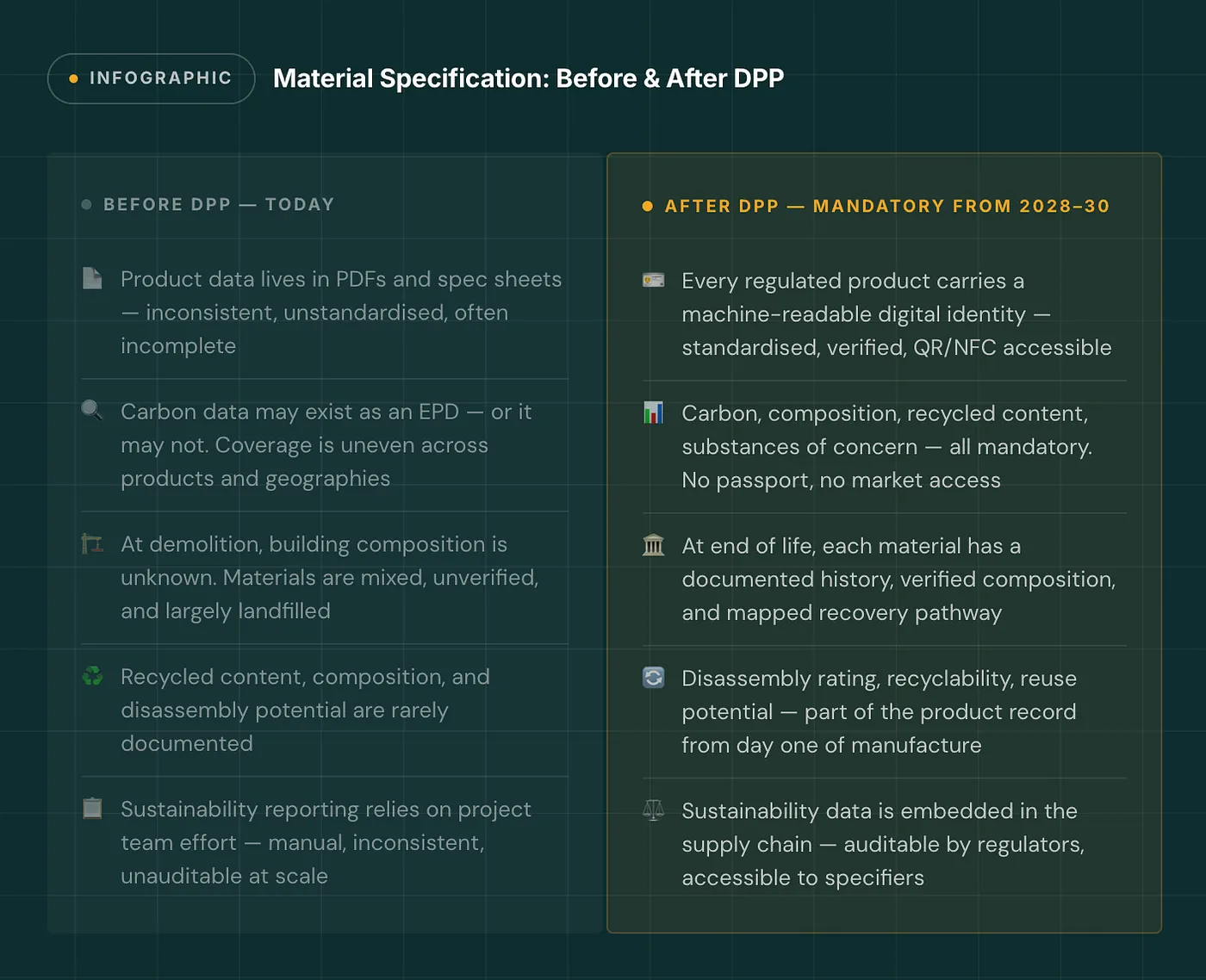
For architects, this means the materials you specify will need to carry this documentation as a condition of being on the EU market not as a sustainability gesture, but as a legal requirement. For developers, the buildings you commission will have a material record that affects their circularity value, compliance standing, and asset value at end of life.
 A material passport is a digital record of the materials within a building including location, composition, embodied carbon, circularity attributes, and disassembly potential that shifts materials from being disposable inputs to recoverable assets. — Digital Construction Week
The Regulation That Activates the Framework
The DPP isn’t a reaction to a new problem it’s the regulatory architecture that puts a decade of material passport thinking into enforceable practice. It’s embedded across two pieces of EU legislation working in tandem. The Ecodesign for Sustainable Products Regulation (ESPR, Regulation EU 2024/1781) entered into force in July 2024 and establishes the horizontal DPP framework across the entire EU economy. The revised Construction Products Regulation (CPR, Regulation EU 2024/1305), adopted in December 2024, tailors those requirements specifically to the built environment. Together, they do what a decade of voluntary pilots couldn’t: make the digital material record a legal condition of market access.
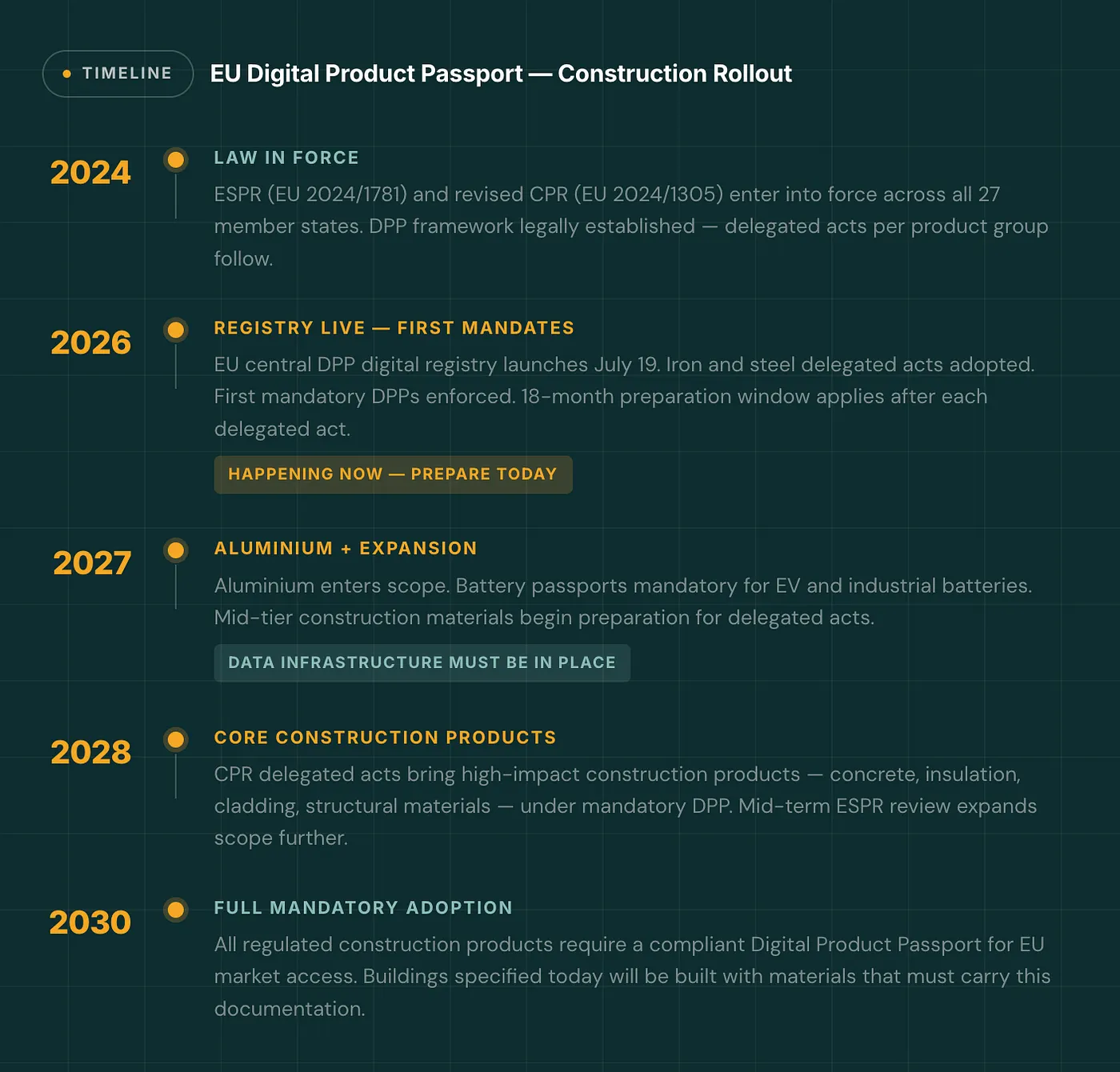
The 18-month preparation window that applies after each delegated act sounds generous. It isn’t. Building the data infrastructure standardised product records, digital identifiers, lifecycle traceability takes time that most manufacturers haven’t started spending. The clock is already running.
What the Passport Actually Contains
The concept of a material passport has always described the same thing: a complete, accessible digital record of what a building is made of, where those materials came from, and what happens to them when the building’s life ends. The DPP operationalises that description into mandatory, standardised, machine-readable fields accessible via QR code, NFC, or API, and required to remain live for a minimum of 5 to 10 years post-sale. Here’s what one looks like in practice:
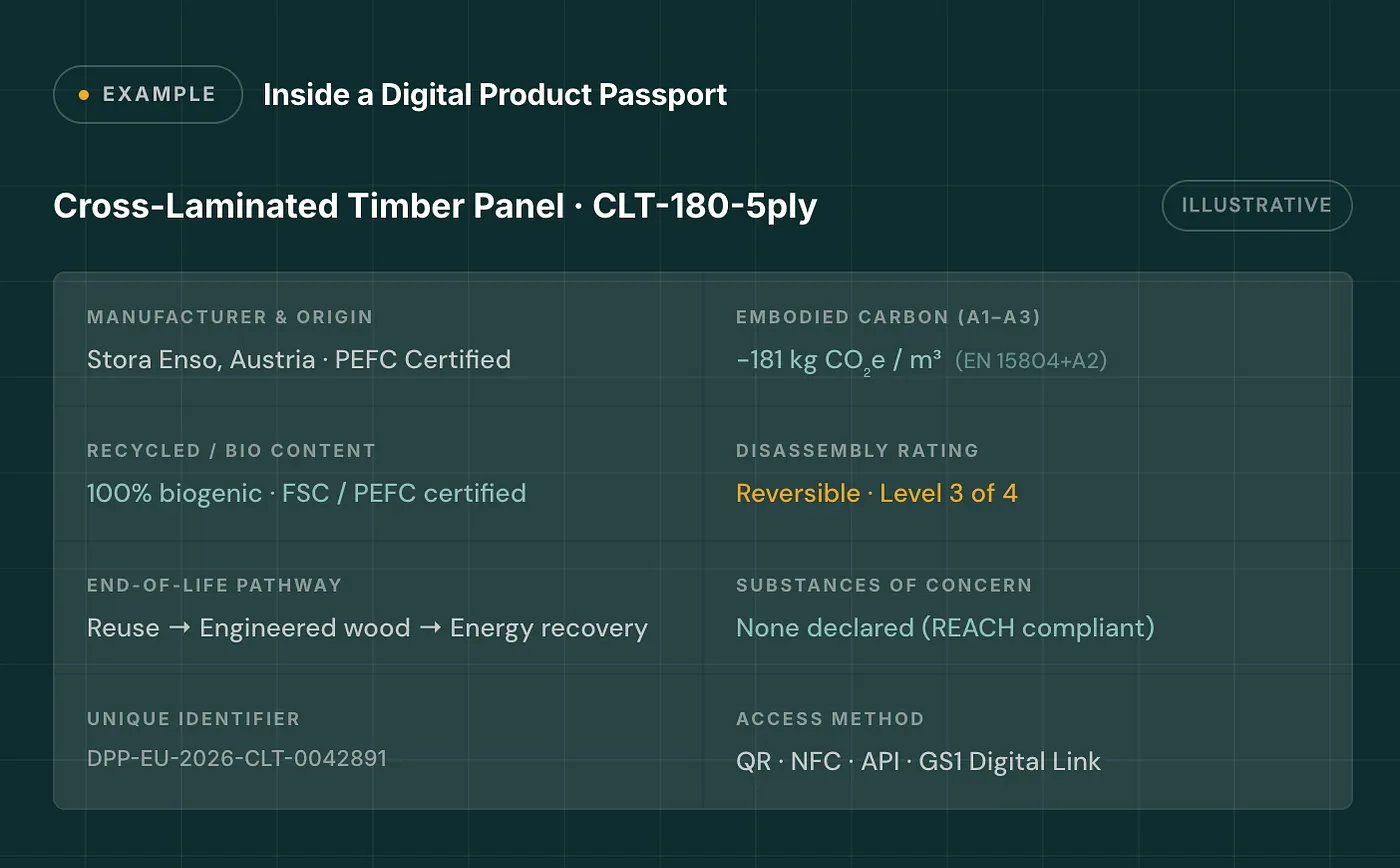
Every field in that card is a mandatory disclosure requirement under ESPR and CPR. The business placing the product on the EU market is legally responsible for its accuracy and that record must remain accessible long after the sale is complete.
EPDs Feed In. The Passport Goes Further.
If your team has been doing the work on embodied carbon specifying EPD-backed materials, building lifecycle carbon into design decisions that work is directly relevant here. EPDs don’t get replaced by DPPs; they get incorporated. EN 15804+A2-compliant EPD datasets are explicitly expected to feed into the DPP framework for construction products. An EPD provides the carbon chapter of a product’s passport. The passport itself is the full document: composition, origin, circularity attributes, disassembly potential, chemical disclosure, and regulatory compliance, all in a single interoperable record.
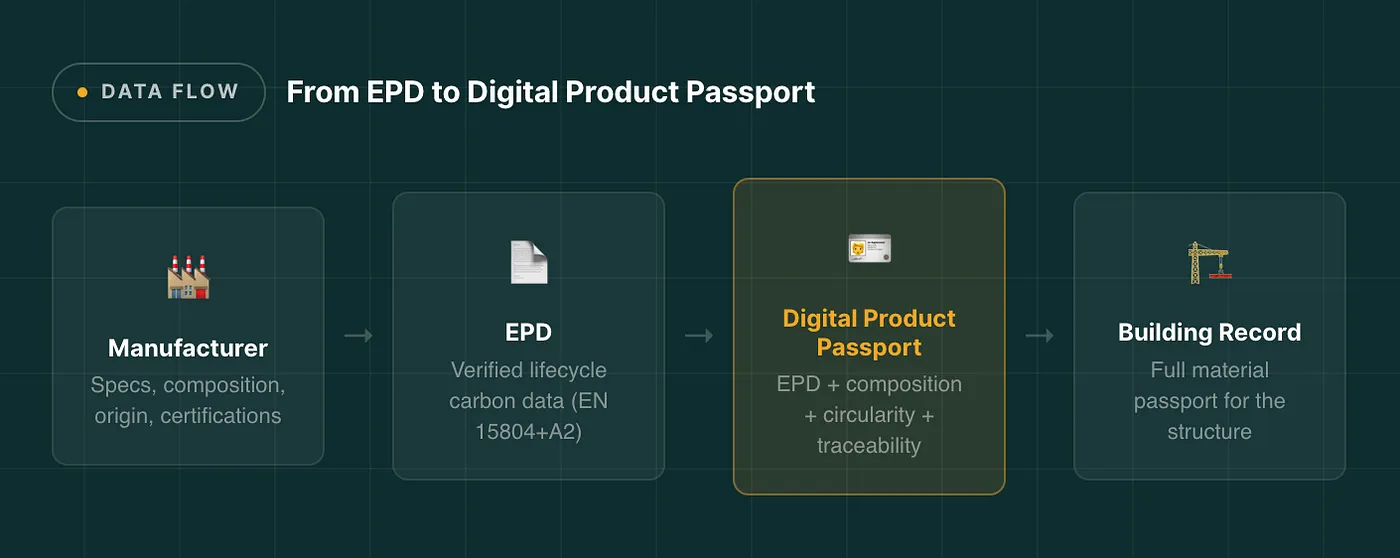
Teams that have been building EPD discipline have a meaningful head start their carbon data is already structured and third-party verified. The DPP extends that work upward: origin traceability, circularity metrics, chemical disclosure, unique digital identifiers. The direction has always been toward this. The regulation is what closes the gap between intention and requirement.
The Gap the Regulation Exposes
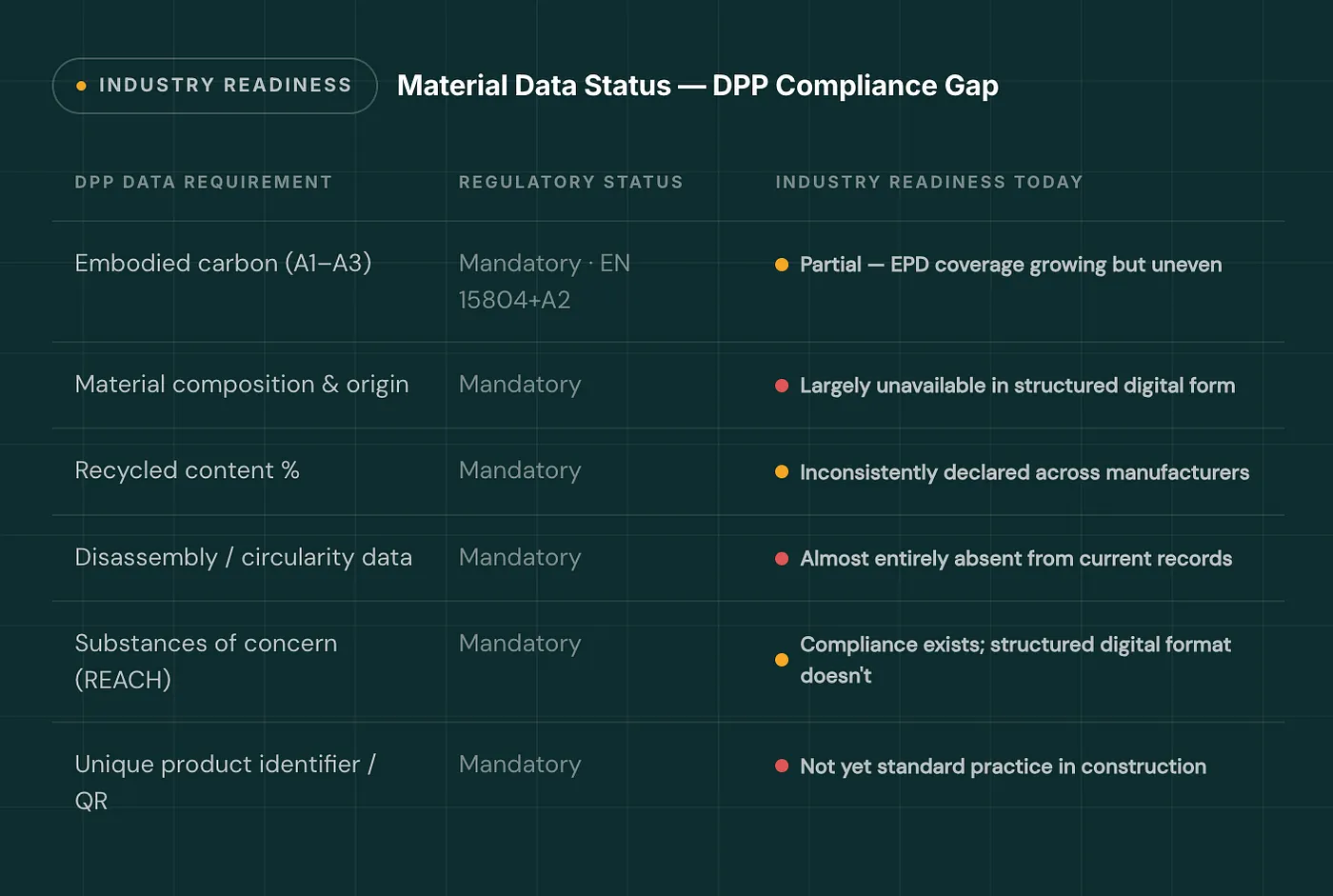
The DPP doesn’t create the industry’s data problem, it reveals it. The requirement for structured, standardised, machine-readable product data across the full passport scope isn’t new in concept. What’s new is that it’s now law, and the gap between what the industry has and what the regulation requires is suddenly measurable. A 2025 peer-reviewed study in Building & Environment found no unified approach to DPP data content in construction. A separate systematic review of 549 papers found fragmented data architectures and lack of interoperability as the primary barriers to scalability. The passport framework was ready. The data infrastructure behind it wasn’t.
The Opportunity in the Gap
The DPP requires product-level data infrastructure to exist before enforcement arrives which means the companies structuring their data now are building compliance readiness as a byproduct of doing good work. Manufacturers with verified, structured product data already have the foundation. The question is how much of the rest of the passport they can fill. Those who haven’t started will be building under pressure once the delegated acts land.
What the Research Confirms
The academic community has been tracking material passports closely for years and as the DPP regulation has sharpened, so has the research. The consistent finding across recent literature is that the concept is sound and the use cases are well established. What the studies identify now are the practical conditions required to take it from proven pilots to infrastructure at scale.
1. Materials Sustainability (Nature, 2025) — Eight Recommendations for Material Passport Adoption
Published in a Nature portfolio journal, this perspective paper presents eight evidence-based recommendations for accelerating material reuse through passports. Key finding: interoperability between platforms and databases must be prioritised as a precondition for scalability. Construction accounts for nearly 40% of global energy-related CO₂ emissions.
nature.com → npj Materials Sustainability
2. Building & Environment (ScienceDirect, 2025) — Stakeholder Perspectives on DPPs for Construction
First peer-reviewed study mapping the requirements, barriers, and perspectives on DPP implementation for construction products. Four critical requirements: access control, data quality, flexibility, and inclusivity. Standardisation of data content is the sector’s central unresolved challenge.
sciencedirect.com → Building & Environment
3. Taylor & Francis (2025) — Digital Material Passports in AEC: A Scoping Review
Comprehensive scoping review of 549 papers (2019–2024). Conclusion: while material passport prototypes have multiplied, adoption pathways remain unclear due to inconsistent data architectures. Standardisation is the missing link.
tandfonline.com → Architectural Engineering Technology
4. UKGBC (2025) — Materials Passports: EPDs and Circular Construction
Construction and demolition accounts for 60% of the UK’s total material use and waste. UKGBC guidance makes clear that passports require not just EPD data, but standardised, structured composition, deconstructability, and circularity data — all of which needs to function at scale.
ukgbc.org → Materials Passports Guidance
ukgbc.org → Materials Passports Guidance
Where 2050 Materials Fits in This Story
Material passports have always required one thing above all else: reliable, structured, machine-readable product data. Not PDFs. Not spec sheets. Not manually assembled carbon estimates. Verified, standardised, digitally accessible records of what a product is, where it came from, and what it contains the kind of data that a digital passport can be built on top of.
That’s been 2050 Materials’ work from the beginning. The platform organises sustainability data for over 182,475 construction products with EPDs, whole lifecycle impact, recycled content, manufacturer-verified attributes, chemical certifications in structured, searchable, machine-readable form. Not as a DPP compliance product. As the underlying data infrastructure that the industry needs regardless and that the DPP now requires.
How 2050 Materials Connects to DPP Readiness
For manufacturers: Your product data on the 2050 Materials platform EPDs, carbon data, material composition, certifications is already structured in the format that DPPs will require. Building your data presence now means your compliance readiness is already underway.
For architects and specifiers: The platform lets you verify the data quality of every material you specify, identify products that already carry the transparency attributes DPPs will mandate, and build a project record that maps directly onto future passport requirements.
For developers: Buildings with documented, DPP-ready material records will have a measurably stronger position with insurers, lenders, and future occupiers than those without.
The EU is building the regulatory scaffolding. The registry launches this year. The delegated acts are being written. Material passports are no longer a pilot programme or a sustainability aspiration; they’re becoming the operating standard for every product on the European construction market. The DPP is the moment the industry has been building toward. The question now is simply whether your data is ready for it.
Sources & Further Reading
- European Commission. Ecodesign for Sustainable Products Regulation (ESPR), Regulation (EU) 2024/1781. July 2024.
- European Commission. Construction Products Regulation (CPR), Regulation (EU) 2024/1305. December 2024.
- Charef, R. et al. “Eight recommendations to adopt materials passports.” npj Materials Sustainability, 2025. nature.com
- Jensen, P. et al. “Stakeholder perspectives on DPPs for construction.” Building & Environment, 2025. sciencedirect.com
- Markou, I. et al. “Current methodologies of creating material passports.” Case Studies in Construction Materials, 2025. sciencedirect.com
- “Digital material passports in the AEC industry: a scoping review.” Taylor & Francis, 2025. tandfonline.com
- UKGBC. “EPDs and Materials Passports in Circular Construction.” 2025. ukgbc.org
- One Click LCA. “Digital Product Passport: What’s a DPP.” 2025. oneclicklca.com
- ESPR Working Plan 2025–2030. European Commission, April 2025.
- Digital Construction Week. Material Passports: Data Infrastructure for the Built Environment. 2024.
Related articles
Reading Between the EPD Lines
Two EPDs can report almost the same A1 to A3 carbon figure and still deserve very different levels of trust. Here is how to read the fine print.
Read more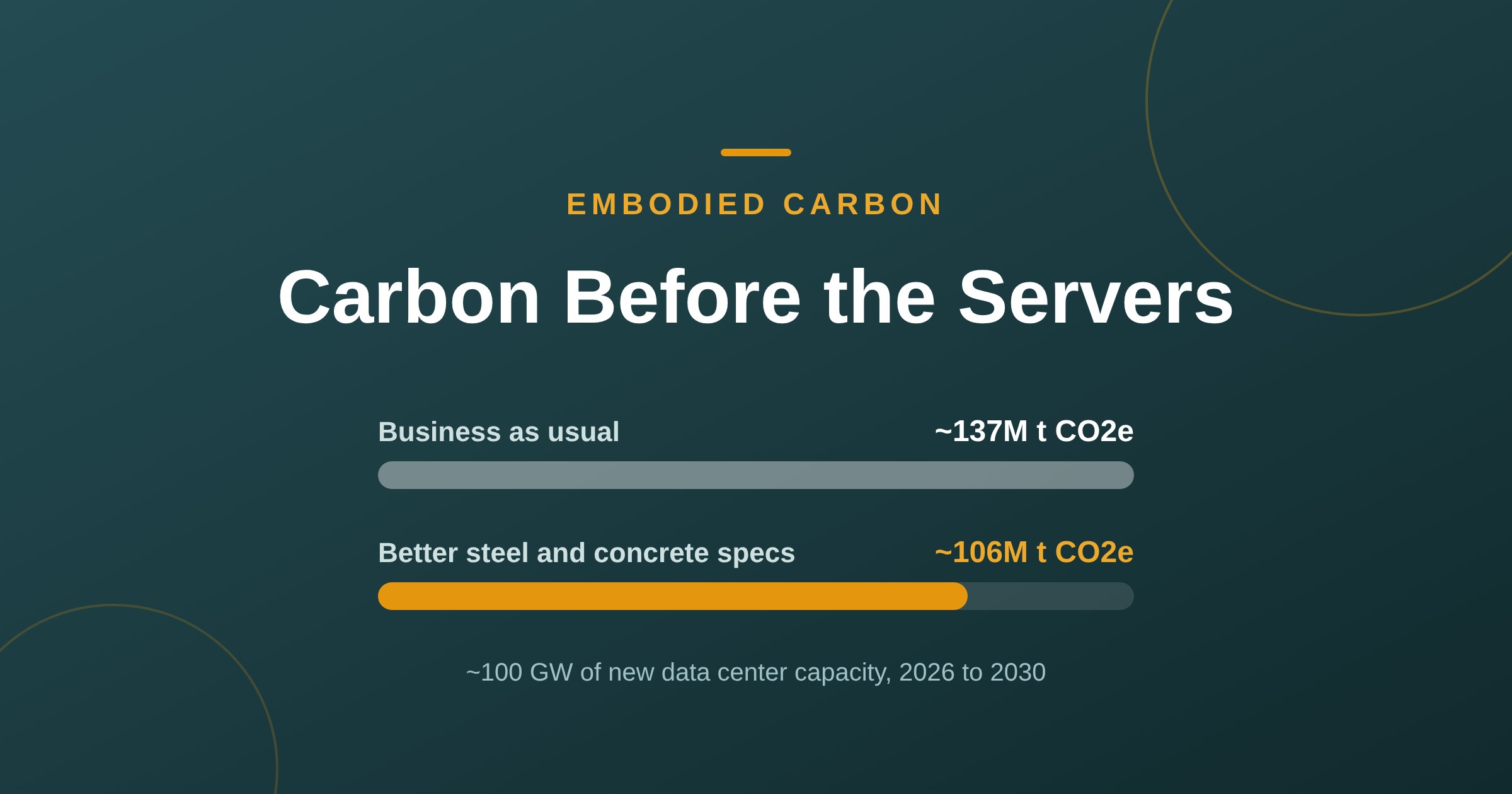
Data Centers’ Hidden 137M-Tonne Carbon Bill
New data centers could lock in ~137M tonnes of CO2e before a single server switches on. GGBS concrete and recycled steel could cut about 31M of it.
Read more
Built to Beat the Heat
This summer's drought wasn't a fluke, it was a preview. Here's the material data that actually decides whether a building shrugs off a heatwave or quietly cooks behind a great winter U value: decrement delay, solar reflectance, SHGC, and the real products behind each one.
Read more