10 uses for construction product sustainability data outside LCA tools
“You’ll need a full Life cycle Assessment tool for that.”
This has been the default reaction whenever anyone in the built environment asks for embodied carbon data. It’s true if your output is a regulatory LCA report. It’s untrue almost everywhere else – and the “everywhere else” is where the work is happening.
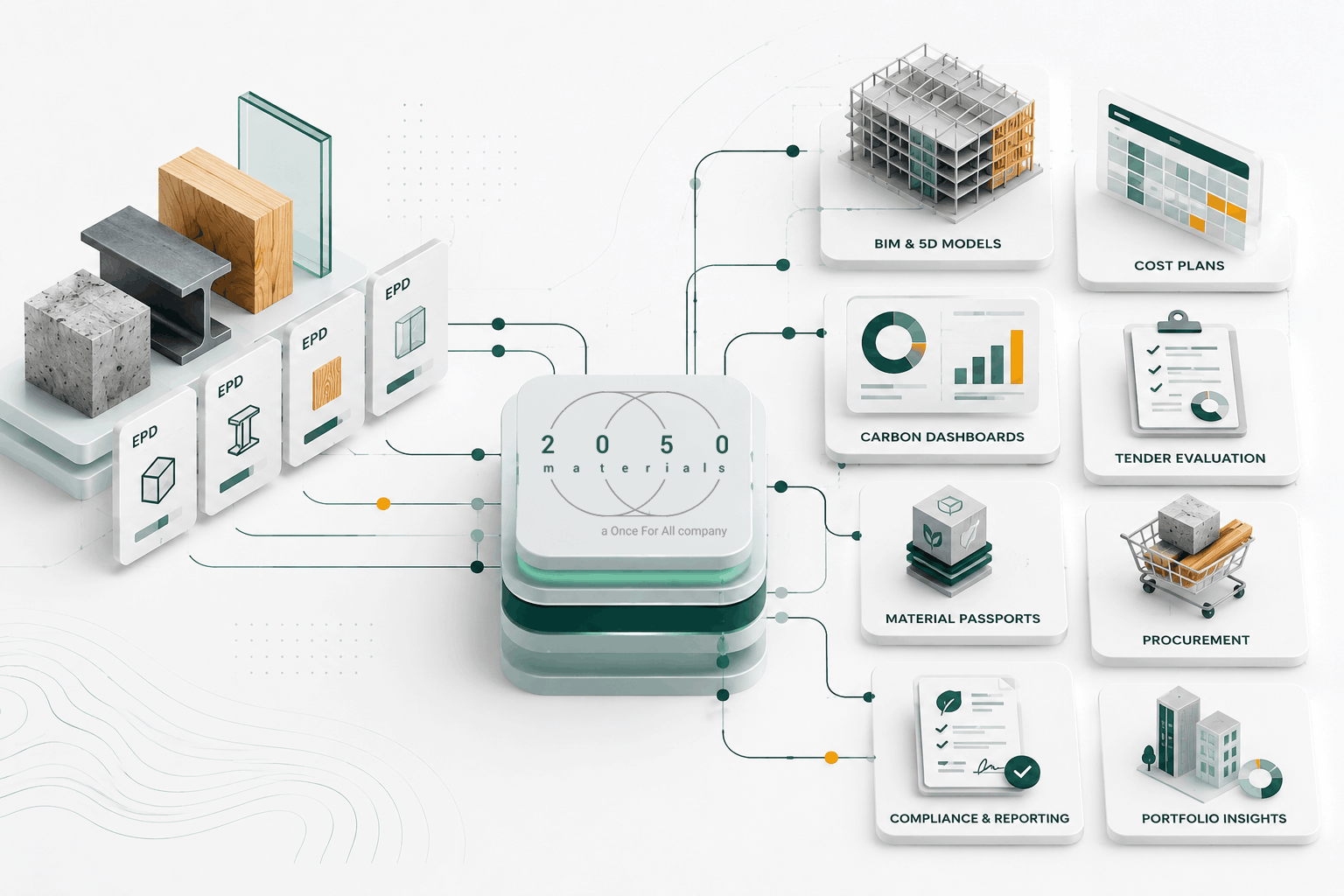
While traditional life cycle assessment tools generate compliance reports, raw sustainable building materials product data integrates directly into daily construction workflows. Quantity surveyors and cost consultants can use Application Programming Interface (API) feeds to embed carbon data into 5D Building Information Modelling (BIM), cost plans, and value engineering, calculating emissions and costs simultaneously.
Whenever professionals in the built environment ask for embodied carbon data, the default response is often a recommendation to buy complex life cycle analysis software. If your goal is to generate a regulatory compliance report, a dedicated platform is certainly necessary. However, the true value of environmental product declaration (EPD) data extends far beyond the final report. The real work happens inside cost plans, planning submissions, and tender scores.
This comprehensive guide outlines:
- What an LCA is
- Top 10 ways to use material and product sustainability data outside of full life cycle assessment tools
- How to stay ahead of regulatory demands and client expectations
- How incorporating an LCA can support your ESG initiatives
What is an LCA – Life Cycle Assessment?
A life cycle assessment (LCA) evaluates the environmental impacts of a product or building throughout its entire existence. While a formal lca assessment is essential for final certification, the raw data behind it is what drives daily decision-making. Today, professionals need immediate access to this data to make informed choices during the design and planning phases.
Quantity surveyors and cost consultants are perfectly positioned to lead this transition. Because these professionals already manage the bill of quantities, adding carbon metrics transforms a standard financial deliverable into a comprehensive cost and carbon plan.
1. 5D BIM: carbon as the sixth column of a cost plan
Quantity surveyors have integrated the cost dimension into Building Information Modelling (BIM) for over a decade. The next logical column is carbon. By matching every bill of quantities line item to a product-level EPD via an API, the same model that produces a cost plan can produce a carbon plan for the planned use of materials in construction. You maintain the exact same quantities but apply different unit rates.
According to RICS1, quantity surveyor-prepared quantities must serve as the primary input for a carbon life cycle assessment. This integration transforms a single-deliverable engagement into a dual-deliverable service with no additional measurement effort. Choose API-driven data integration if eliminating double-handling matters more to your firm than generating standalone reports.
2. Cost plan to carbon plan conversion at every RIBA stage
The formal cost plan maps directly onto life cycle carbon assessment workflows. Elements like cubic metres of concrete, tonnes of rebar, and square metres of glazing each possess a specific carbon factor. Professionals can assess these elements with progressively better data through Royal Institute of British Architects (RIBA) stages one to four.
Quantity surveyors now produce 17% of whole life cycle carbon assessments2, representing a massive shift from previous years. Using LCA stage-appropriate carbon factors allows consultants to apply generic data at early stages and product-specific data at later stages. This mirrors the existing rhythm of a financial cost plan, making product life cycle assessment an intuitive and chargeable deliverable.
3. Carbon value engineering and product substitution
Project teams can achieve 19% to 46% embodied carbon savings3 with less than a 1% cost premium. Furthermore, substituting traditional cement for low-carbon cement alternatives (such as hempcrete) delivers substantial savings, often at a flat or negative cost.
The core quantity surveyor skill set involves comparing products on cost. Extending this to compare products on both cost and carbon is a natural progression. The output is a marginal abatement cost curve, which identifies the cheapest tonne of carbon saved first. You should use a carbon value engineering framework if finding cost-neutral sustainability wins is your primary objective. This approach relies on granular, product-level data paired directly with financial costs, something a standalone life cycle analysis software package cannot easily provide.
4. GLA and London Plan WLCA template submissions
Every referable planning application in Greater London4 now requires a whole life cycle carbon assessment at the pre-application, planning, and post-construction stages. Applicants must submit this data using the Greater London Authority (GLA) prescribed spreadsheet template5.
Crucially, quantity surveyor sign-off on the quantities is required for these submissions. Incorporating product-level EPD data sharpens the accuracy of the numbers and reduces the risk of planning officers rejecting the assessment for relying on generic defaults.
The 2050 Materials API provides a verified embodied carbon database with data on a variety of materials in construction which will integrates directly into these templates, streamlining the compliance process for hundreds of referable schemes annually.
5. Part Z readiness and voluntary benchmarking
Part Z6 is a proposed UK Building Regulation amendment that would mandate whole life cycle carbon assessments and product-level disclosures for major projects. Major contractors and developers are already asking if their portfolios will pass these upcoming benchmarks.
Evaluating portfolio readiness is fundamentally a quantity surveying task. Product-level EPD data is the only credible way to retroactive benchmark recent projects and build an internal register of passes and fails. Firms that implement automated data tracking today will bypass compliance bottlenecks when regulations inevitably tighten.
6. Buy clean tender evaluation and carbon-weighted scoring
Public sector procurement is rapidly changing to prioritise sustainability. Policies like the United States Buy Clean initiative7 require product-level global warming potential disclosures and apply strict caps on high-impact materials like steel, glass, and asphalt. UK construction procurement policies are moving in the same direction, with large public buyers scoring tenders based on EPD-backed data.
Quantity surveyors typically manage tender evaluations. Adding carbon-weighted scoring is the strategic next step. By using an API to feed carbon data into existing tender evaluation spreadsheets, procurement teams can identify supply chains that offer significant embodied carbon reductions without needing to log into external LCA software.
7. Buy clean tender evaluation and carbon-weighted scoring
The RICS Whole Life Carbon Assessment standard (2nd edition)8 became mandatory for regulated firms in July 2024: this standard tightens data quality requirements and demands specific, product-level data during the later RIBA stages. Generic database values are acceptable for initial estimates, but they will not suffice for detailed design stages.
Failure to comply is now a professional conduct issue for RICS members. EPD data accessed via an API and applied directly to quantity surveyor measurements represents the highest quality input available for compliance.
8. Practice portfolio dashboards and carbon reporting
Architects, cost consultancies, and contractors increasingly demand portfolio-wide data roll-ups. A firm might need to know that its typical office building generates 580 kilograms of carbon dioxide equivalent per square metre (kgCO2e/m2), while a typical residential project generates 720.
These internal benchmarks help firms win bids, support annual reporting, and track progress against Science Based Targets initiative (SBTi) pledges. Connecting the 2050 Materials API to business intelligence tools allows firms to stream data from BIM models directly to leadership dashboards, turning isolated LCA construction data into actionable business intelligence.
|
🌿
|
2050 Materials partnered with VIM to enrich Building Information Modelling (BIM) data and enable real-time carbon tracking with dynamic dashboards. |
9. BIM-embedded carbon counters
Modern design tools now surface live carbon numbers alongside the model during the authoring process. This allows architects and designers to make decisions in real time, rather than waiting weeks for a report from a separate life cycle assessment software tool.
When a design model lands on a quantity surveyor’s desk, every element already carries a specific carbon tag. This eliminates rework and ensures that the financial budget and the carbon budget remain perfectly aligned from day one.
10. Material passports and residual-value registers
Digital material passports build a permanent record of every product installed in a building9. These registers track material composition, disassembly notes, recyclability, and projected residual value. According to industry estimates, residual material value can account for up to 15% of a building’s cost at the end of its life.
The European Union Digital Product Passport regulation10 is making this data infrastructure mandatory in phased rollouts. For refurbishment-focused quantity surveyors, building a residual-value register using verified product data provides a distinct competitive advantage for future valuation and salvage operations.
Next steps: Integrate carbon data into your existing construction procurement workflows
The cost plan you already produce is a highly effective carbon plan waiting to be unlocked. While dedicated life cycle assessment tools serve an important purpose for final certification, the operational future of construction carbon calculator processes relies on integrated data.
By pulling verified EPD data directly into your spreadsheets, BIM models, and tender evaluations, you can calculate costs and emissions simultaneously. The 2050 Materials platform offers access to over 180,000 EPDs through three robust API endpoints, allowing your firm to automate compliance and drive sustainable decision-making across every project phase.
|
📊 |
Ready to see 2050 Materials in action and discover how embodied carbon is calculated from material data – helping you strengthen your ESG credentials and deliver more competitive tenders? |
Key takeaways
- Look beyond LCA tools: Full life cycle assessment software like 2050 Materials is essential for final compliance reports, but most of the day-to-day value of sustainability data sits in cost plans, planning submissions, and tender scores.
- One dataset, two plans: Product-level EPD data lets you produce a cost plan and a carbon plan from the same quantities, turning a single deliverable into a dual cost-and-carbon service.
- Carbon fits the RIBA rhythm: Quantity surveyors can apply generic factors at early stages and product-specific data later, mirroring how cost plans already evolve from stage one to stage four.
- Compliance is raising the bar: RICS WLCA, GLA template submissions, Part Z, and Buy Clean-style tender scoring all increasingly demand verified, product-level carbon data rather than generic defaults.
- Integration drives better decisions: Feeding verified EPD data straight into your spreadsheets, BIM models, and tender evaluations lets firms calculate cost and carbon together, making faster, more informed choices across every project phase.
FAQs
What is life cycle assessment data best used for outside of reporting?
Life cycle assessment data is best used to integrate carbon metrics directly into cost plans, Building Information Modelling (BIM) workflows, and value engineering exercises. This allows project teams to make real-time decisions about material substitutions and track carbon budgets alongside financial budgets without leaving their primary software tools.
How do quantity surveyors use a construction carbon calculator?
Quantity surveyors use construction carbon calculators by matching their existing bill of quantities line items to product-specific carbon emission factors. Using an API to pull data from platforms like 2050 Materials, surveyors can multiply material quantities by their respective carbon rates, generating a dual cost and carbon plan automatically.
Why is product life cycle assessment data better than generic data?
Product life cycle assessment data provides the specific environmental impact of a material manufactured by a precise supplier, whereas generic data relies on broad industry averages. You should choose product-specific data if accuracy, regulatory compliance, and tender competitiveness matter more than high-level, early-stage estimations.
What is LCA software required for in modern construction?
LCA software is required for generating formal, certified compliance reports at the end of a project to satisfy green building standards like BREEAM or LEED. However, for day-to-day design decisions, cost planning, and tender evaluations, teams increasingly rely on raw data APIs that feed carbon metrics directly into their existing project management tools.
Related articles

Inside HIMACS’ 2026 range: 15 new colours, five Red Dot wins
Five HIMACS Terrazzo colours won a Red Dot Design Award 2026, and four carry SCS-certified recycled content. See the full 2026 range and the EPD data behind it.
Read more
e4E Brick Slips: All the Brick, None of the Kiln
e4E makes brick slips from excavated soil, pressed rather than fired. See how they are made, the formats you can specify and the verified EPDs behind the range.
Read more
CaraGreen’s Organoid Wildspitze: A Wallcovering Grown, Not Manufactured
CaraGreen's Organoid Wildspitze is a wallcovering made from hand cut alpine hay, backed by a third party verified EPD showing 2.2 kg CO2e/m² GWP and stored biogenic carbon.
Read more